
Three Mills of the Victor Mill Syndicate Castle Mill Oakwood Mill
Victor Mill
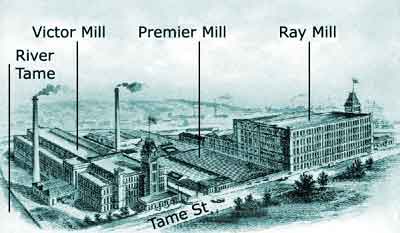
This former mill was located on the south-west side of Tame St and it was bordered by the river Tame to the south.
It was built of red enginering brick in 1903/04 by the Victor Mill syndicate, who also constructed the adjacent Premier Mill (1906/07) and Ray Mill (1907/08).
Premier Mill was next door and Ray Mill was next door but one. Victor Mill was the first mill in Tameside built entirely for ring spinning and it used American and Egyptian cotton.
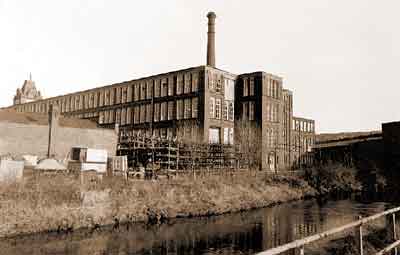
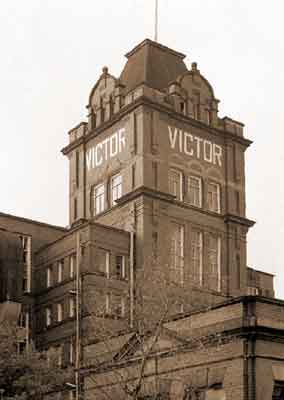
The architect for the design of this 4-storey, red engineering brick mill was the renowned Sir Philip Sidney Stott of Oldham. A notable feature was the square water tower crowned with a rectangular cupola. When it opened it had 77,000 spindles powered by a 1,500 IHP inverted vertical triple expansion steam engine built by George Saxon & Co Ltd of Openshaw, Manchester.
In 1910/11 the three Stalybridge mill companies merged to form Victor Mill Ltd, employing around 1,500 workers. In 1929 Victor Mill Ltd was acquired by the Fine Cotton Spinners and Doublers Association and in 1960 it was taken over by the Courtaulds Northern Textiles Division. In 1982 the mill ceased production and in 1985 it was demolished. The site was then re-developed for industrial use.
Premier Mill
The former Premier Mill, built of red enginering brick in 1906/07 to a design by Sir Philip Sidney Stott, was the second mill to be built by the Victor Mill Syndicate and
it was the first mill in Tameside to be designed and powered by electricity from the outset. Its design was unusual for cotton mills in that it was a single-storey building.
When it opened it was fully integrated with 21,000 ring spindles and 1,017 looms, all driven by electric motors. It obtained its electricity supply from the Tame Valley Generating Station.
The sequence of ownership of Premier Mill was the same as for Victor Mill.
Ray Mill
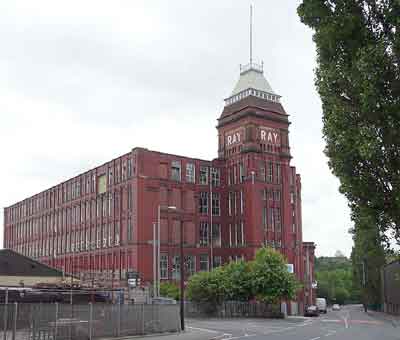
The former Ray Mill, built of red enginering brick in (1907/08) to a design by Sir Philip Sidney Stott, was the third mill to be built by the Victor Mill Syndicate.
It was also fully electrically powered from its start, taking power from the Tame Valley Generating Station.
This 5-storey mill was built with red engineering brick and a notable feature was the square water tower crowned by a cupola. It contained 66,528 ring spindles and 9,000 doubling spindles.
The sequence of ownership of Premier Mill was the same as for Victor Mill but it survived demolition in 1985 to be put to alternative use.
However, on the 17 Mar 2018 a huge devastating fire broke out in the mill and it was so badly damaged that it was subsequently demolished. The building was housing 15 businesses at the time of the fire.
The locations of the three Victor Mill Syndicate Mills are as follows:
Victor Mill: 53.4801, -2.0723
Premier Mill: 53.4809, -2.0732
Ray Mill: -53.4817, -2.0741
Tame Valley Generating Station: 53.47932, -2.07310
This former cotton-spinning mill was located on the north-west side of Dale St (53.48122, -2.06787) between Peel St to the east and Quay St (no longer extant) to the west. The back of the mill was bordered by the river Tame. It was built in 1891/92 for the Castle Spinning Co Ltd and the architects for its design were Potts, Son, & Pickup of Clegg St, Oldham, and Manchester. The mill was 4-storeys high, about 292-feet long on Dale St by 149-feet wide on Quay St. It was especially is notable for its innovative design with a corner tower embellished with mock turrets and battlements, inspired by the name of the company. The use of closely-set paired windows to maximise natural light was also a prominent feature of this mill.
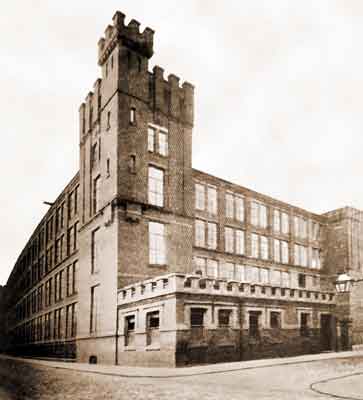
Cotton carding machines were provided by John Hetherington & Sons Ltd of Vulcan Works, Pollard St, Ancoats, Manchester, and other preparatory textile machinery was provided by Samuel Brooks (aka Brooks & Doxey) who were textile machinery manufacturers of the Union Iron Works, West Gorton, Manchester. Spinning-mule frames carrying 87,972 spindles were provided by Taylor, Lang & Co of the Castle Iron Works, Back Grosvenor St, Stalybridge. Castle Spinning Co Ltd specialised in the spinning of weft and twist (warp) with medium counts (20s to 39s) using American cotton.
The mill was powered by a 1,400 hp horizontal triple expansion engine provided by Yates and Thom Ltd of the Canal Ironworks/Canal Foundry, Manner Sutton St, Blackburn. The 32-rope flywheel rotated at 60 rpm, had a diameter of 30 feet and weighed 52 tons. The boilers were provided by John Fernihough & Sons who were well-known boiler makers of the Victoria Boiler Works, Yew Tree Ln, Dukinfield.
In 1930 the Castle Spinning Co Ltd was taken over by the Lancashire Cotton Corporation Ltd who later closed the mill. Subsequently, it was used for alternative purposes and by 1966 it was occupied by Messrs Sterling Moulding Materials Ltd. The mill was demolished in 2009.
Oakwood Mill, located on the north side of Grenville St (53.49402, -2.03382), was built in the 1850s but is now derelict. On the south side of Grenville St was Staley Mill and both mills were originally worked by the Staly [sic] Mill Co. Later, both mills were worked by the associated companies, Staley Mill Co Ltd and the Millbrook Spinning Co Ltd but Staley Mill is no longer extant. The fireproof Oakwood Mill was built of millstone grit and it originally had a slate roof. It is 3-storeys high by 13 bays long. The crenellated clock tower is dated 1857 and it is likely that the mill was completed around this time.
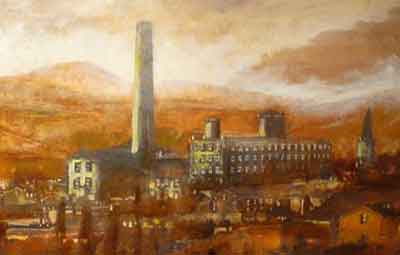
The mill specialised in the manufacture of spun yarn with medium counts of twist per inch (TPI). In the manufacture of spun yarn, a medium twist produces optimum smoothness and softness of the woven fabric.
At first, the mill was powered with a beam engine but in 1908 this was replaced by a triple-expansion steam engine built by Yates & Thom Ltd of the Canal Ironworks/Canal Foundry, Manner Sutton St, Blackburn. This was housed in a new engine house with internal white-glazed bricks. New boilers and rope drives were also installed. By 1911 this engine was powering 59,000 mule spindles and 7,000 ring spindles.
Both mill companies went into liquidation in 1935 and the machinery was sold off in 1937. Oakwood Mill then stood vacant until it was repurposed to house Italian Prisoners of War during the World War II. After the war the mill returned to industrial use, including cotton spinning (until 1961) and bleaching and dyeing by the Dukinfield Bleaching Co Ltd. In Feb 2018, the mill suffered a major structural failure when floors collapsed due to heavy ice and rain.
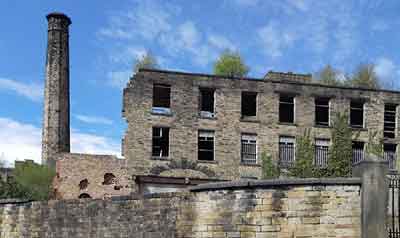
The derelict Oakwood Mill is Grade II listed, List Entry No. 1084302.
