
Copley Mills Castle Street Mills Bankwood Mill Rassbottom Mills & David Harrison Henry Street Mill Water Street Mill Soot-Poke Mill
These cotton-spinning mills were built in the 19th century (1827-1871) and they are located on the south side of Huddersfield Rd about 125 yards to the north east of St Paul’s Church (53.48575, -2.04224). They are historically significant as they are one of Tameside’s earliest surviving fire-proof mills.
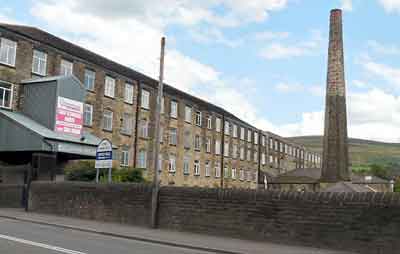
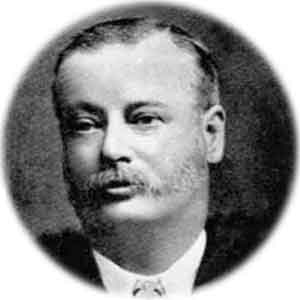
They were worked by James Wilkinson from at least 1832 and there is a record of a company called James Wilkinson, Ltd working the mills in 1891. By 1920 the mills had become disused but in 1930 Robert Hyde Buckley & Sons Ltd began to use them specifically for cotton doubling and they worked them until 1974. In the textile industry, cotton doubling is the process of twisting together two or more single cotton yarns to create a single, multi-ply yarn. The machine used to 'double' spun cotton is known as a 'doubler' or 'doubling machine'. The founder of this company, Robert Hyde Buckley (6 Dec 1812-12 Sep 1867), was born at Dukinfield and he was resident at Saddleworth. The sons in the business were Robert Shaw Buckley, Richard Buckley and James Buckley. Copley Mill was acquired by the Amalgamated Cotton Mills Trust Ltd in 1919. This acquisition occurred through the Trust's purchase of Robert Hyde Buckley and Sons Ltd.
The mills are built with watershot stone, with a graduated-slate hipped roof, and they are of fireproof floor construction supported by cylindrical cast-iron columns. The hipped roof has been partly replaced with a flat roof. They are 4 and 5-storeys high and 11-bays wide against Huddersfield Rd and 4-bays wide at the far end, by 45-bays long. The boiler house, octagonal tapering chimney, and engine house on the south west side date from 1871 and the office wing is on the north-east side.
Copley Mills are listed Grade II, List Entry No. 1162996 and they are in the Copley Conservation Area.
Also known as Cheetham’s Mill or Longlands Mill (53.48296, -2.05909), this is the oldest surviving cotton-spinning mill in Stalybridge as the complex dates from 1805 when the first mill was built by George Cheetham (1757-1826). It was used to spin yarn for the hosiery industry and it became famous for its high-quality goods. The company was known as George Cheetham & Sons, the sons being, David (1797-1874) and John (1802-1886). John Frederick Cheetham (1835-1916), the son of John Cheetham, was also in the business.
.jpg)
.jpg)
The two sons expanded the business in 1831 when they opened Bankwood Mill at the bottom of Park St, formerly Gas St (53.48070, -2.04971).
Ranges were added to the 1805 mill in 1820/21 and 1827 with later alterations which were all completed before 1850. The surviving 1820/21 range was erected between Castle St and the river Tame, aligned north/south beside Caroline St, and a parallel range was added on the eastern side of this. The two parallel ranges were connected by cross wings fronting Castle St and the river Tame to form a courtyard. An archway in the 1820/21 range has a keystone dated 1820.
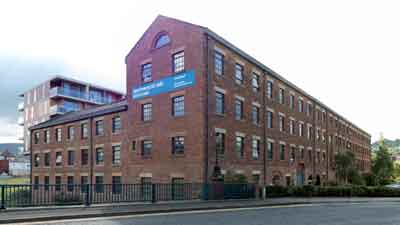
The surviving 1820/21 range is 4-storeys high by 24-bays long alongside Caroline St. Beside Castle St it is 4-storeys high by 5 bays with 3 lights (one large round-headed light flanked by smaller lights) in the gabled tympanum, and beside the river Tame it is 3 and 4-storeys high with one round-headed light in the gabled tympanum.
Castle Street Mills closed in 1896 but in the 1920s they were reopened by the Longland Mill Co (Stalybridge) Ltd as spun cotton and spun rayon doublers. Rayon was first introduced in the late 19th and early 20th centuries, though it was then known as ‘artificial silk’. The name ‘rayon’ was not adopted until 1924 in the United States. The Longland Mill Co (Stalybridge) Ltd went into liquidation in 1961.
The surviving 1820/21 range of Castle Street Mills is listed Grade II, List Entry No. 1338882.
‘Rassbottom Mills’ is a collective historical term used to describe the dense cluster of early cotton mills located in the Rassbottom District of Stalybridge and centred around Chapel Street Mill, which was the oldest (53.48291, -2.06198).
Notable mills included in the cluster were:
Chapel Street Mill, built in 1797, was historically known as Harrison’s Mill and nicknamed ‘The Bastille’ in a direct reference to the famous Parisian prison and fortress.
Lees’ Mill.
Henry Street Milll.
Castle Street Mills.
Water Street Mill.
Prior to the arrival of cotton mills in Stalybridge there was some domestic wool production in the Rassbottom District but in 1776 the district saw its first water-powered cotton mill and this marked a shift away from domestic production into industrial production. In 1795 the industrialists, Thomas Harrison, John Lees, John Leech, and George Cheetham acquired land around this cotton mill to expand production but in c.1816 this partnership split. Following the opening of Chapel Street Mill (Harrison’s Mill) in 1797, a 40 IHP steam engine was installed in 1799 which significantly improved cotton production. By 1803, this mill had become the largest industrial building in the immediate area, with 34,000 spindles.
The Rassbottom cluster was targeted by the Luddites between 1811 and 1816, a movement that organised insurrections of textile artisans with the purpose of destroying automated industrial machinery. They were also a target of the Plug Riots in 1842, also known as the 1842 General Strike. This was a wave of industrial strikes and protests that swept across the United Kingdom from July to September 1842.
Some of the mills in the Rassbottom cluster closed and were demolished early in the 19th century to make way for the expanding railway network (the Ashton Branch of the Lancashire and Yorkshire Railway).
The Great Depression in the 1930s hit Stalybridge heavily, forcing some of the town's largest cotton mills to close. The remaining active mills in the Rassbottom cluster survived the 1930s by moving away from textile production and repurposing.
David Harrison (1791–1872) was a prominent industrial pioneer, cotton master, Magistrate, and Deputy Lieutenant who co-owned, expanded, and managed some of Rassbottom cluster of mills in Stalybridge.
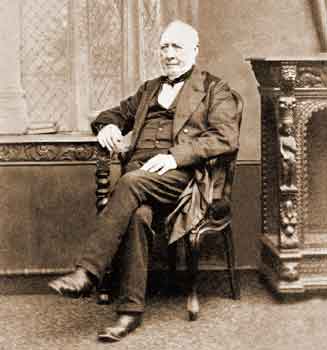
His connection with the cluster was rooted in his family's industrial operations. In 1795 his father, Thomas Harrison, partnered with John Lees, John Leech, and George Cheetham to purchase land in the Rassbottom District to harness the water power of the river Tame. Following a series of mishaps, including fires and partnership reshuffles, the partnership split in c.1816. Thomas Harrison then took sole control of operations, with his son, David Harrison.
Eventually, under the stewardship of David Harrison and his son, Thomas Ashton Harrison, the business expanded its activity in the Rassbottom District significantly. They operated two mills there, Chapel Street Mill and Henry Street Mill. Chapel Street Mill was six-storeys high and it was powered by an 80 IHP Boulton & Watt steam engine. In 1891 these two mills contained 50,000 spindles and 926 looms which made them fully integrated.
David Harrison’s highly successful operations transformed him into one of the wealthiest and most influential cotton masters in the area. As a philanthropist, he used his wealth to fund local civic life, including co-founding the Stalybridge Gas Light Co, to bring modern infrastructure to Stalybridge. In 1825 he laid the foundation stone for the Stalybridge Mechanics' Institution which became an important educational and cultural centre in the town. David Harrison was resident at Thompson’s Cross House in Stalybridge with his wife, Mary Ashton, son, Thomas Ashton, and daughter, Mary. This house was located about 117 yards to the north of the junction of Stamford St and Rassbottom St (53.48629, -2.06504).
He operated the family business for decades before eventually passing it down to his son, Thomas Ashton Harrison. The business was eventually incorporated as T A Harrison & Co Ltd and it continued to spin cotton yarn at the Chapel Street and Henry Street Mills until late in the 19th century.
Henry Street Mill was located alongside the left bank of the river Tame with Henry St on the opposite side (53.48268, -2.06351). Henry St is no longer extant but it was off the north-west side of Bridge St.
A specific construction year for this mill was not recorded but it is likely that it was built at the end of the 18th century as part of the expansion of the Rassbottom cluster of mills. The Harrison family jointly operated Henry Street Mill with the nearby Chapel Street Mill, which dates from 1797, so it is likely that Henry Street Mill dates from around the same year. Henry Street Mill was on the south side of the river Tame while Chapel Street Mill was on the north side and the two mills were about 115-yards apart.
The Harrison family business was eventually incorporated as T A Harrison & Co Ltd. By 1891 the joint mills of T A Harrison & Co Ltd had 50,000 spindles for spinning and 926 looms for weaving, making them fully integrated.
During the post-World I decline of the Lancashire's cotton industry, operations at T A Harrison & Co Ltd collapsed. Henry Street Mill permanently ceased operations in 1933 and the mill was demolished shortly afterwards. It is understood that that the jointly owned Chapel Street Mill survived and it was not until 1985 that this mill was demolished.
Water Street Mill was located alongside the right bank of the river Tame close to the place where Caroline St crosses the river (53.48293, -2.06193).
In 1795 the land in the Rassbottom District was purchased by the Lees Brothers and Abel Harrison (Lees & Harrison) from Samuel Ousley. They chose this location alongside the river Tame due to its water-power potential but in the event, this was not used. When the mill opened in 1797 it was one of the earliest mills in the area to rely on steam power rather than water power using waterwheels. By 1811 it was operating 13,000 mule spindles. It was powered by a 10 IHP Boulton & Watt, !5-foot beam engine with a stroke of 4 feet, driving a 12-foot diameter flywheel. In 1819 a further 36 IHP Boulton and Watt beam engine was ordered and first beam engine was sold to a Mr Thornley of Hadfield.
By the turn of the 19th century, Water Street Mill was operating alongside a cluster of other early textile mills in the Rassbottom District of Stalybridge, including Chapel Street Mill and Castle Street Mill, turning the immediate area into a dense cluster of cotton mills that were historically known as the ‘Rassbottom Mills’.
In 1867 the Water Street Mill Co Ltd was incorporated. Later, due to advances in textile technology and mill architecture, the mill became inefficient and uneconomic to keep operating and as a result it ceased operating and was demolished in 1896.
By 1750 there were already a few, small woollen mills in Stalybridge, based along the river Tame to take advantage of the supply of water-power. However, the first water-powered cotton mill in Stalybridge† (and Tameside) was built by Edward (Neddy) Hall on a street named Wood Street in 1776. It is understood that this mill was somewhere near Waterloo Rd. If this supposition is correct, then the nearest known weir in the river Tame that could have supplied water to the mill is near Corporation St (53.48322, -2.05463). It is known that at some point in its history that water from this weir once powered a corn mill. The present Wood Street in Stalybridge is not near the river Tame.
Soot-Poke Mill was a small mill, the size of a cottage, and its carding machine was powered by a waterwheel, while its spinning jennies were hand operated. A 6 IHP beam engine was installed in the 1790s and the chimney used to carry away the heavy-dark smoke from the boiler gave the mill its name of 'Soot-Poke Mill' (poke meaning pocket). By 1803 the mill had been extended and was being worked by George and Joshua Platt, who operated 4,200 spindles until 1815/16. They then left Soot-Poke Mill to build another mill on Bridge St.
Sadly, Soot-Poke Mill burned down in 1824.
