
St Helens Mill, Dukinfield Woodend Mill, Mossley Brunswick Mill, Mossley
This cotton mill is located on the north-west side of Crescent Rd and it is also known as Crescent Road Mill. The mill was a new build in 1819 by Joshua Binns (3 Apr 1817-1875) and by 1824 he had built a second range in partnership with James Dean. The company traded as Binns, Dean, and Company and the partners were Joshua Binns, James Dean and John Binns. The 1851 Census records that Joshua Binns was resident on Crescent Rd with his wife, Sarah Townsend, and daughter, Sarah Shaw.
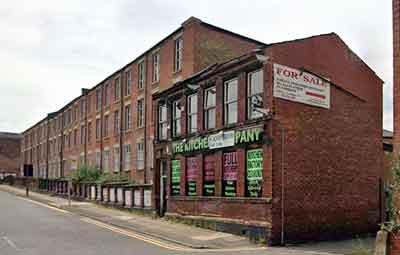
Other companies known to have worked St Helens Mill are:
The mill is of all brick construction with floors of fireproof construction supported by cylindrical cast-iron columns.
From the outset the mill was steam-powered and it is notable for being an early combined cotton mill that from the outset incorporated both spinning and weaving facilities*. The OS 25 Inch, 1892-1914 shows a chimney in the courtyard, so it is likely that this was then the site of the boiler house.
The main spinning range faces Crescent Rd and this is 4-storeys high by 23-bays long. This was built in three phases and the central portion (bays 9 to 14) was built in 1819 and this was named, ‘New Mill’. This makes it one of the oldest surviving cotton-mill buildings in the Tameside district. Additional buildings were in 1824, 1833-40 and 1845. The site is complex with five ranges grouped around a triangular courtyard and smaller ranges within the courtyard.
St Helens Mill is listed Grade II, List Entry No. 1268063.
This cotton mill is located on the south-east side of Manchester Rd alongside the river Tame and the Huddersfield Narrow Canal and it was built by Robert Hyde Buckley. It is notable for being an early combined cotton mill that from the outset incorporated both spinning and weaving facilities.
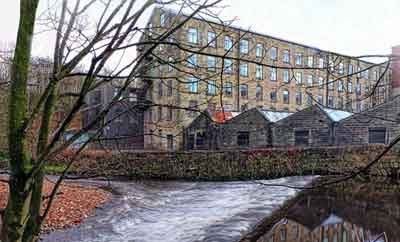
The mill was erected in several phases between c.1830 and 1840 and it was built with coursed and squared stone rubble exterior walls, and slate roofs. The floors are of fireproof construction supported by cylindrical cast-iron columns. It was expanded in 1862/64 when a larger mill building was added. By 1891 the company had become incorporated and was styled Robert Hyde Buckley & Sons Ltd.
Woodend Mill is listed Grade II, List Entry No. 1268030.
This former cotton mill was located in the Micklehurst District of Mossley on the south side of Staley Rd on the corner of Cheshire St (53.513, -2.035). Although its origins date back to 1839/40, a large range was built by the Brunswick Cotton Spinning Co Ltd in 1886/87, which is sometimes referred to as Albert Mill. At this time the mill had a capacity of 87,000 spindles producing fine twist (warp) and weft yarn. The mill is notable for being one of the earliest mills in the district to introduce electricity to drive textile machinery.
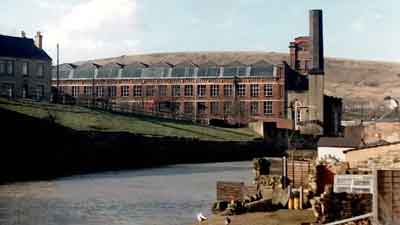
After the Great War the cotton industry experienced a brief boom during 1919/20 but in early1921 there was a crash that marked the beginning of a terminal decline in the industry. Demand for cotton plummeted in a single season and cotton imports into Liverpool dropped by 50%. However, the Brunswick Cotton Spinning Co Ltd must have been experiencing difficulties prior to this and the London Gazette recorded in Mar 1920 that the company was to be liquidated. Somehow, the mill remained open throughout the interwar and post WWII eras but following the sharp post WWII decline of the cotton industry, operations eventually ceased in the 1960s.
The London Gazette records that over the period 1967/70 the mill was occupied by the Mossley Wool Combing & Spinning Co Ltd*. Subsequently, it was used for light industry and as a music rehearsal space but it was demolished in 1990 to make way for housing development. This housing estate was named ‘The Spindles’ in remembrance of the former Brunswick Mill.
