
Lymefield Mill Broadbottom Mills Arrowscroft Mill Woolley Bridge Mill Hodge Print Works Best Hill Print Works
This mill is located on the right bank the river Etherow in Broadbottom in the historic parish of Mottram in Longdendale. It was built from local stone in the 1860s and its early owners were John Marsland followed by Edward Platt.
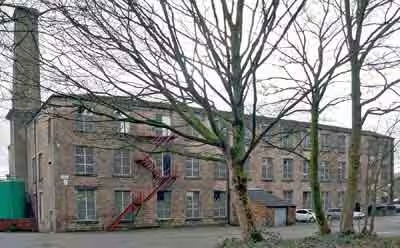
In 1889 it was acquired by Broadbottom Mills Co Ltd to be combined with the neighbouring Broad Mills complex, which was about 345-yards distant to the west. By 1891, these integrated, cotton spinning and weaving mills housed 60,000 spindles and 1,197 looms across spinning, weaving, and print operations.
In 1904 the Broadbottom Mills Co Ltd went into liquidation and reformed as Broad Mills Co Ltd. In the 1920s a depression in the North-West cotton industry caused economic collapse and Broad Mill Co Ltd went into liquidation in 1934. However, a devastating fire in the 1940s led to the complete demolition of the neighbouring Broad Mills complex in 1949 but Lymefield Mill survived intact.
In 1976, the textile company, Tiviot Prints Ltd, relocated its expanding business from Stockport into Lymefield Mill. The move allowed them to transition from traditional hand-screen printing to large-scale multicolour flatbed and rotary machine printing.
These former mills, later known as Broad Mills, were located on the right bank of the river Etherow in Broadbottom in the historic parish of Mottram in Longdendale. Founded in c.1802 by William and George Sidebottom, the site contained three multi-storey cotton spinning mills by 1824. Eventually the site grew into a large cotton manufacturing centre.
Initially, the mills were powered by water wheels supplied with water from a weir in the river Etherow. These were augmented by steam-driven beam engines in the 1830s to increase production.
In 1850, another family member, John Sidebottom, added a large weaving shed and warehouse. By 1860, the complex was operating about 25,000 spindles and 1,500 looms, and employing around 1,200 workers.
Between 1860 and 1865 the American Civil War caused the Lancashire Cotton Famine by cutting off supplies of raw cotton, forcing the mills to close. They reopened in 1870 and in 1872 they were purchased by John Hirst & Sons. In 1889 they were restructured as Broadbottom Mills Co Ltd. At this time the new company also acquired the neighbouring Lymefield Mill.
In 1904 the Broadbottom Mills Co Ltd went into liquidation and reformed as Broad Mills Co Ltd. In the 1920s a depression in the North-West cotton industry caused economic collapse and Broad Mill Co Ltd went into liquidation in 1934. Subsequently, parts of the complex were repurposed when they were leased to a commercial sawmill and a carpet factory. In 1949, a devastating fire tore through the remaining buildings, causing severe structural damage that forced the demolition of most of the historic buildings.
The remains of these buildings were eventually reclaimed by nature and turned into a protected reservation and heritage site. Currently, visitors exploring the area can walk the ½-mile long loop path of the Lymefield and Broad Mills Heritage Trail.
This former mill was located on the south-east side of Market St, Hollingworth, on the corner of the modern Highfield Gardens. It was in the historic parish of Mottram in Longdendale.
The mill was built in 1873 for the Hollingworth Cotton Spinning and Manufacturing Co Ltd. A late Georgian residence, known as Arrowscroft House, built in c.1820, became the residence for the early owners of Arrowscroft Mill. This house is about 160 yards due east of the mill site and it is now listed Grade II, List Entry No. 1162753.
The later succession of owners of Arrowscroft Mill is very convoluted. It was owned by the Hollingworth Cotton Spinning and Manufacturing Co Ltd until the late 1870s. The industrialist Thomas Rhodes (1815-1883) owned the mill from the late 1870s until 1859 when he transferred his main operations to his newly built Mersey Mill in Woolley Bridge which was about 600-yards distant to the east. However, it seems that he maintained ownership of the mill for a while but leased it. Thereafter, the Co-operative Wholesale Society (CWS) took over the running of the mill as part of their expanding venture into manufacturing. Historical records then show that John Gartside & Co Ltd was operating Arrowscroft Mill by 1891. This major North-West company operated the mill alongside other local mills such as the nearby Albion Mill which was about 475-yards away to the west. By the mid-1950s the mill had been acquired by the Calico Printers' Association Ltd (CPA) to operate as a specialised textile printing resource.
In its final years, 1970s to 1982, the mill was repurposed and divided into smaller commercial units housing local firms such as Pennine Plastics Ltd and Louvre Blind Co Ltd. However, in 1982 a major fire broke out in Arrowscroft Mill and it was so badly damaged that it was subsequently demolished.
This former water-powered cotton mill, also known as Lees Mill or Bridge Mill, was located on the west side of Woolley Bridge about 65 yards from the junction of Woolley Bridge with Woolley Ln and Woolley Bridge Rd. It was bordered on the opposite side by the river Etherow.
It was built in 1825 by Henry Lees (7 April 1794 - 24 July 1870) who was the son of Robert Lees, the owner of Padfield Brook Mill. When it first opened it is understood that it had about 4,680 spindles. By the 1840s it had grown into a medium-sized mill employing around 200 workers.
During the American Civil War (1860-65) the supply of raw cotton to the North-West collapsed, causing the ‘Cotton Famine’. The cotton manufacturing industry suffered heavily and during this period Henry Lees became locally famous for his humanitarian response. He purchased cooking equipment in order to provide hot meals and soup for his tenants and mill workers. His actions to relieve distress were praised and mill owners throughout Longdendale and neighbouring Glossopdale were urged to follow his example.
Henry Lees operated the business with his son, Robert Lees, and following his death in 1870 the business was styled Henry Lees & son, before being sold off in 1881 to George Fawcett, who converted the mill into a basket and skip manufacturing plant. In 1890 the building was altered to serve as an iron works and in 1903 it was modified again to be used as a dye works.
In 1908 the building was converted into a cinema named the Woolley Bridge Picture Palace. There were additional plans for building alterations later approved by the local council in Feb 1913. Consequently, in 1914 the cinema’s licence was amended to enable it to feature live stage plays and theatrical productions, complete with new dressing rooms and safety features. In 1925 the cinema closed and in 1929 the building caught fire and burnt down. Ironically, the very last film screened at the location before the fire was a silent film titled Cinders.
This former print works was located on the south-east side of Hodge Ln and it was bordered by the river Etherow on the opposite side. Broadbottom Mills were about 390-yards distant due east.
It is recognised as being one of the earliest known textile sites in Tameside. Situated alongside the river Etherow, it represents a progression of the Industrial Revolution, moving from early wool processing to high-quality fabric finishing.
The site began its industrial life as a water-powered woollen mill in 1798 but in 1805 it was converted into a print works undertaking textile bleaching, dyeing, and printing. It became well known for producing exceptionally high-quality dyed and printed cloth. The skills were so refined that samples of the textiles produced here are preserved at the Victoria and Albert Museum in London.
Historical and archaeological accounts show that the bleaching and dyeing processes at Hodge Print Works were kept entirely separate.
The first process was to bleach the ‘grey cloth’, which was done in two stages. In the first stage the cloth was treated with calcium hydroxide (slaked lime) and in the second stage it was treated with calcium hypochlorite (chloride of lime). The latter was made by reacting dry slaked lime with chlorine gas, and the site did have a gas holder.
Once the cloth had been bleached white it would undergo the second process of dyeing and for this it was taken to the dye vats where it was dyed to the required colour. The most prominent surviving remains of the print works are the Hodge Lane Dye Vats. These consist of an array of vats constructed from large stone slabs securely bound together with heavy iron stays and they are about 6-feet deep.

After bleaching and dyeing, workers carried the wet cloth to the adjacent ‘croft’ where it was laid out flat to be dried by the sun. The word ‘croft’ is an Old English word meaning an enclosed area, such as a field, right next to a mill or dwelling.
The third and final stage was to print the cloth. In the 19th century, cloth printing moved from being a slow handcraft into a highly mechanised industrial process using roller printing with engraved copper cylinders. This technical innovation allowed manufacturers to rapidly mass-produce intricate, multi-coloured textiles, most notably calico cotton fabrics, at a fraction of their previous cost.
The Hodge Print Works site formed one self-contained, interconnected industrial community that featured Hodge Villa for the use of the owners or high-level management while Hodge Hall was located within the Hodge Print Works site and was probably used as offices. Workers were housed in weavers’ cottages at Hodge Fold on the south side and Summer Bottom on the north side.
This former cotton mill was located on the west side of Long Ln bounded by the river Etherow on the opposite side. It was about 155 yards north of Best Hill Bridge where Long Ln becomes Lower Market St. Although this mill is in High Peak it is also in the historic parish of Mottram in Longdendale.
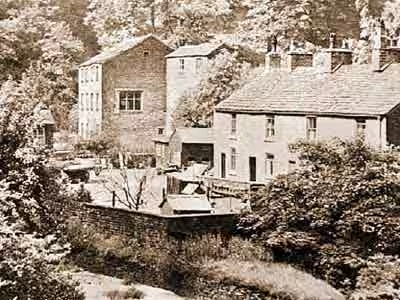
The mill was built in 1784 by John Marsland and by 1842 it had reached its peak, employing 90 women and 30 men who earned an average wage of 10s - 8d per week.
The American Civil War (1860-1865) caused a cotton famine by cutting off supplies of raw cotton, forcing some mills to close but Best Hill Mill survived.
The event that precipitated the end of cotton processing at the mill was a dispute over road rights between the Marsland family and Lord Howard, Lord of the Manor of Glossop (Edward George Howard, 1st Baron Howard of Glossop (1818-1883)). This caused considerable ill will that resulted in Lord Howard refusing to renew the land lease and this forced the mill to close in 1884.
Early in the 20th century, the Horne Brothers, based at Hague in Broadbottom, which is about 325 yards to the north of Best Hill Mill, purchased the former mill and repurposed the machinery to manufacture a large range of plain and decorative tape and ribbons.
During World War I the former mill moved production to aid the war effort. Products included webbing, tape, and even shell casings for munitions.
The economic hardships of the Great Depression forced the former mill to stop operating completely in 1930. This depression lasted from 1929 until 1939. It was triggered by the US stock market crash in Oct 1929, reaching its lowest point in 1933, and then recovering by 1939 due to preparations for World War II.
The exact demolition year for Best Hill Mill is not recorded but it is likely that it occurred around the mid-20th century period. Currently, the only surviving trace of the mill are four workers cottages standing directly below Broadbottom Viaduct at Best Hill Bridge.
