
Woodend Mill Brunswick Mill Hollins Mill Milton Mill Scout Mill
This cotton mill is located on the south-east side of Manchester Rd (53.52055, -2.03541) alongside the river Tame and the Huddersfield Narrow Canal and it was built and operated by Robert Hyde Buckley (1812-1867). It is notable for being an early combined cotton mill that from the outset incorporated both spinning and weaving facilities.
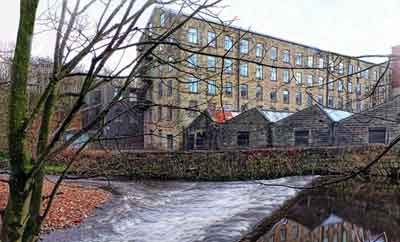
The mill was erected in several phases between c.1830 and 1840 and it was built with coursed and squared stone rubble exterior walls, and slate roofs. The floors are of fireproof construction supported by cylindrical cast-iron columns. It was expanded in 1862/64 when a larger mill building was added. By 1891 the company had become incorporated and was styled Robert Hyde Buckley & Sons Ltd.
Woodend Mill is listed Grade II, List Entry No. 1268030.
This former cotton mill was located in the Micklehurst District of Mossley on the south side of Staley Rd on the corner of Cheshire St (53.513, -2.035). Although its origins date back to 1839/40, a large range was built by the Brunswick Cotton Spinning Co Ltd in 1886/87, which is sometimes referred to as Albert Mill. At this time the mill had a capacity of 87,000 spindles producing fine twist (warp) and weft yarn. The mill is notable for being one of the earliest mills in the district to introduce electricity to drive textile machinery.
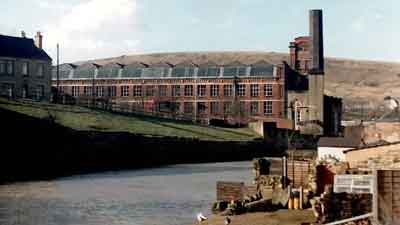
After the Great War the cotton industry experienced a brief boom during 1919/20 but in early1921 there was a crash that marked the beginning of a terminal decline in the industry. Demand for cotton plummeted in a single season and cotton imports into Liverpool dropped by 50%. However, the Brunswick Cotton Spinning Co Ltd must have been experiencing difficulties prior to this and the London Gazette recorded in Mar 1920 that the company was to be liquidated. Somehow, the mill remained open throughout the interwar and post WWII eras but following the sharp post WWII decline of the cotton industry, operations eventually ceased in the 1960s.
The London Gazette records that over the period 1967/70 the mill was occupied by the Mossley Wool Combing & Spinning Co Ltd*. Subsequently, it was used for light industry and as a music rehearsal space but it was demolished in 1990 to make way for housing development. This housing estate was named ‘The Spindles’ in remembrance of the former Brunswick Mill.
Hollins Mill
Micklehurst Rd, Mossley,
Tameside
This stone-built woollen mill was located on the south side of Micklehurst Rd (53.51419, -2.03142), bordered by the modern Cocksfoot Drive and Earnshaw Clough. It was erected in 1864 by John and Samuel Buckley, members of a local textile manufacturing family that included the above Robert Hyde Buckley of Woodend Mill, Mossley.
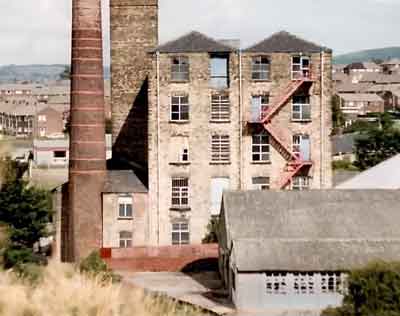
Later, ownership passed to Robert Radcliffe & Sons (Robert Radcliffe (1862-20 Oct 1914)), who also owned the nearby Squire Mill (53.51471, -2.02740) on the south side of Micklehurst Rd. The two mills were about 300 yards away from each other. The first mill to be operated by Robert Radcliffe & Sons was Carr Mill (53.50731, -2.01987) in neighbouring Carrbrook.
Commercial operations at Hollins Mill concluded in the latter half of the 20th century and it became derelict before demolition in 1993.
This mill was located off the east side of Manchester Rd (53.51913, -2.03738) between the river Tame and the Huddersfield Narrow Canal. The shortest access to the mill from Manchester Rd was down a lane at the side of Carrhill Mills and across a bridge over the river Tame. It was built in 1891/92 on the site of the former Cheshire Side Mill and the construction company used salvaged stone from the original mill to construct its basement. It was built for the Milton Spinning Co Ltd and the architects were A H Stott & Sons of Oldham and Manchester.
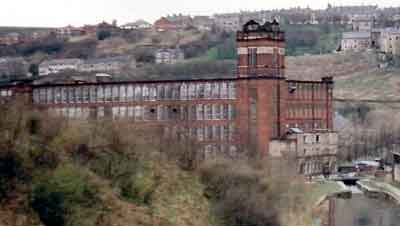
Following World War I there was a depression in the Lancashire cotton industry and Mossley Town Council formed their New Industries Committee which contacted textile firms in Roubaix, near Lille, France. Consequently, a French consortium purchased the empty Milton Mill, and the nearby Border Mill, in September 1932. Border Mill was off Manchester Rd in the Bottom district of Mossley. The new company was known as the Mossley Wool Combing and Spinning Co Ltd. The transition from cotton spinning to wool processing (worsted yarns) had the effect of reviving the local economy. A small French community relocated to Mossley to manage operations and the new company eventually grew to become a large employer in Mossley. Trading was highly successful reaching a peak around 1947 but effectively trading afterwards. Border Mill ceased trading in c.1985 and was demolished but Milton Mill continued trading into the 1990s. After closing, Milton Mill remained vacant until it was demolished in 2002.
The connection forged by the Mossley Wool Combing and Spinning Company led to Mossley twinning with the French town of Hem, near Lille, in 1972.
This former cotton mill was on the north-west side of Manchester Rd and Scout Tunnel of the Huddersfield Narrow Canal is about 130-yards distant on the opposite side of the river Tame.
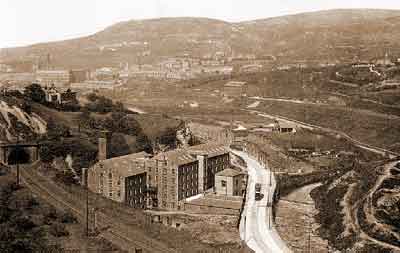
Scout Mill was one of the earliest textile mills in Mossley, serving as a foundation for the town's industrial transformation during the 18th and 19th centuries. It grew from a modest water-powered woollen mill into a large steam-powered cotton-manufacturing centre.
The original Scout Mill was founded in the late 18th century following water rights granted to Andrew Mill in the Bottom district of Mossley in 1765. Scout Mill and Andrew Mill were both woollen mills before cotton arrived to dominate local industry.
In the 1830s the industrialist brothers, John and George Mayall, leased Scout Mill to expand their textile operations and it was at this time that the mill was converted from wool production to cotton production. They modernised the site by replacing water power with a powerful steam engine. Scout Mill then became an important part of their business by collaborating closely with the nearby Britannia, Southend, and Bottom Mills, also owned by the brothers. After 1846 John Mayall (1803-1878) ran the business with his sons, styled as John Mayall & Sons. John Mayall retired in 1872 and his sons continued running the business.
.jpg)
Production at the mill continued to thrive throughout the 19th century, remaining highly active during the peak years of the Lancashire cotton industry. However, in 1893 a fire caused severe structural damage to the mill from which it never completely recovered.
As the Lancashire cotton industry declined in the 20th century the mill eventually ceased cotton production. In the mid-20th century, it was repurposed and used intermittently by smaller industrial trades, workshops and for coal storage. Finally, the mill was demolished by the early 1970s.
