Greencroft Mill Hyde Mill Bayley Field Mill, et al Long Meadow Mill Slack Mills
Greencroft Mill was located on Manchester Rd between Robert St to the west and Water St to the east. It was built in 1802/03 for John Ashton (1780-1846) and it was the first purpose-built cotton mill in Hyde to be steam powered. By 1879 the mill was being worked by Hibbert and Aspland (Edward Hibbert and Arthur Palmer Aspland) but in Dec 1893 Arthur Palmer Aspland stepped down and Edward Hibbert continued the business styled as Edward Hibbert & Co.
In 1879/80 a new mill range was built at Greencroft Mill for Hibbert and Aspland and the architect was Edward Potts of Clegg St, Oldham, one of the greatest mill architects of Victorian Lancashire.
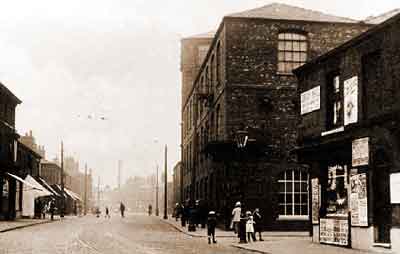
By 1891 the mill had 26,668 mule spindles and 1,480 ring spindles, 141/341 twist (warp) and 161/421 weft, as well as 541 looms, showing that the business was fully integrated for both spinning and weaving. The above twist (warp) and weft values show the range of spinning that the mill could produce.
141/341 twist (warp) is re-written as 14/1 to 34/1. The first value equates to 1 strand of Yarn Count Size 14s cotton and the second value equates to 1 strand of Yarn Count Size 34s cotton. 161/421 weft is re-written as 16/1 to 42/1. The first value equates to 1 strand of Yarn Count Size 16s cotton and the second value equates to 1 strand of Yarn Count Size 42s cotton. 's' stands for 'singles'. For both the warp and weft yarns, the lower Count Size numbers represent thicker heavier yarn, while the higher Count Size numbers represent finer, thinner yarn.
The company specialised in weaving twill and drill fabrics. Cotton twill is a type of weave characterised by its diagonal ribbing and soft texture. Cotton drill is very similar but it is stronger and more resistant to wear and tear, making it more suitable for heavy-duty applications.

Greencroft Mill had a wide-ranging history. Gas lighting was introduced there in 1812 and between 1836 and 1845 it was used as a temporary barracks for the 10th, 20th and 38th Regiment of Foot (Thomas Middleton, 1899) before returning to cotton production under new ownership. Their presence was due to the Chartist Movement (1838-1857). Cotton production ceased in 1932 and in 1938 it was occupied by Crossley Motors Ltd of Gorton, Manchester, for the manufacture of buses. Subsequently, sections of the mill were demolished but the 3-storey and 5-storey ranges fronting Manchester Rd survived until 1987 when they too were demolished.
The former Hyde Mill was located off the north-east side of Ashton Rd, between Gregory Street and Cotton Mills Drive, in the Newton District of Hyde, close to the Dukinfield border. It was built in 1905/06 for the Hyde Spinning Co Ltd on land acquired from the trustees of the late Charles James Ashton (1830-91). It was the last mill to be built in Hyde. The architect for the design was Sir Philip Sidney Stott, a prominent Oldham-based architect known for designing approximately 77 cotton mills across Lancashire according to architectural records.
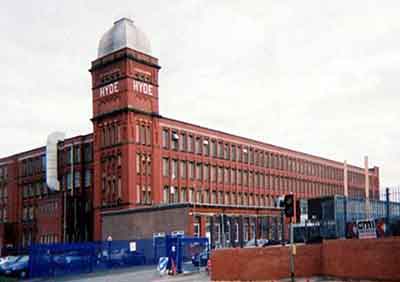
The mill was 4-storeys high by 47-bays long and it was built of red engineering brick. A notable feature was the Italianate-style water tower in the south-western corner, which was square and crowned with a cupola. Internally, the mill utilised triple brick arches supported by steel beams.
When the mill opened it had 116,532 spindles using spinning mule frames powered by a 2,000 horse power inverted triple expansion steam engine. The mule frames were provided by Platt Brothers & Co Ltd of Oldham and the steam engine was provided by George Saxon & Co Ltd of Openshaw, Manchester.
In 1919 the company name was changed to Hyde Spinning Co (1919) Ltd. This change was brought about when the company became part of the Amalgamated Cotton Mills Trust Ltd, which was a major textile conglomerate formed in 1919 during a period of consolidation in the Lancashire cotton industry. This company grew through a series of mergers and acquisitions, eventually controlling many mills before the cotton industry's decline led to its eventual dissolution.
Hyde Mill closed in 1958 and in 1960 it was bought by J A Pattreiouex Ltd. It was demolished in 2009 and the site was re-developed for housing.
This cotton mill was located off the south side of Newton St, bordered on the opposite side by the associated Carr Field Mill. It was built in 1890, of steel-framed construction, adjacent to Bayley Field Coal Pit.
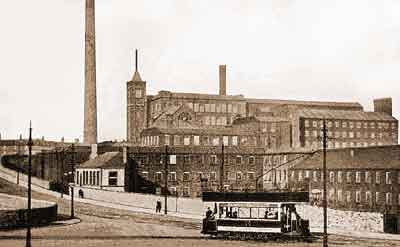
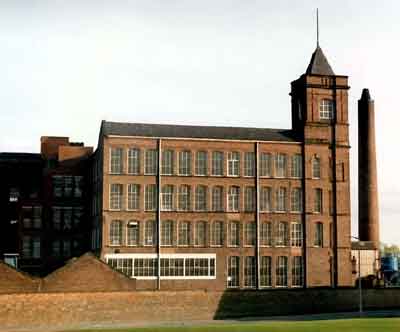
Bayley Field Mill was owned by the Ashton family who were pioneer cotton manufacturers in Hyde since c.1800. The family is notable for the progressive care of the welfare of its mill workers.
They owned a large complex of integrated cotton mills based on Carr Field Mill, Bayley Field Mill, and the nearby Throstle Bank Mill. The latter mill was located on Throstle Bank St by the Lower Peak Forest Canal. The ring-spinning frames used in the mill were said to resemble the singing of a throstle (thrush).
By 1891, the combined operations of Ashton Brothers at their Hyde mills had 114,580 spindles (mule and ring) and 2,200 looms, driving a large output to their Manchester warehouse (Ashton House) on Charlotte St. Later, this production capacity was increased to 182,000 spindles and 4,650 looms.
By the mid-20th century, Bayley Field Mill alone was known for housing complex machinery systems, operating Hattersley looms and Jacquard looms used to create high-quality textiles. Ashton Brothers survived far longer than many North-West cotton businesses.
Bayley Field Mill adapted through the changing textile markets of the 20th century, contributing to the production of the company's famous Abanco fabrics and Zorbit towels well into the post-war era before cotton manufacturing went into decline.
Ashton Brothers, a Timeline
1718: Benjamin Ashton is born. He begins a small cottage-scale textile trading business, laying the foundations for the family's entry into the cotton industry.
His sons are; Samuel, Thomas, James, John, Joseph and Benjamin.
c.1800: Samuel Ashton partners with his brother Thomas to establish Ashton Brothers and Berry, starting operations at Boston Mills in Godley, Hyde (53.45346, -2.07074).
These mills were located off the north side of Mottram Rd between the current arrangement of Brook St and the M67 Motorway.
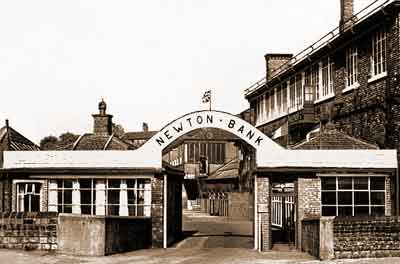
1806: Joseph Ashton establishes the Newton Bank Print Works, founding the family's entry into calico printing.
This works was located on the north side of Hoviley Brow (now Commercial St) (53.45363, -2.07453).
1810: Partner Mr Berry leaves and the remaining Ashton brothers, James, John, Joseph and Benjamin, fully participate in the rapidly growing family business.
1817-18: The original Carr Mill is built.
1820: Samuel Ashton builds the Pole Bank estate in Hyde. The family secures self-sufficient energy by purchasing local coal mines to produce steam for their steam-powered mills. One of them is Bayley Field Coal Pit.
1823: The brothers dissolve their large partnership to split interests. Samuel and Thomas retain the majority shares. Samuel builds Apethorn Mill, while Thomas takes control of Carr Field and Bayley Field Mills.
1824-25: The original Bayley Field Mill is built.
1828: Woodley Mill is built.
1845: Thomas Ashton passes away and his son, Thomas Ashton Jr, takes over management at Carr Field and Bayley Field Mills,
continuing a family tradition of providing good housing for the mill workers and funding day schools.
1854: The compny splits into two distinct branches. Ashton Brothers & Co manages manufacturing, while Thomas Ashton & Sons manages merchanting.
1861–1865: During the Lancashire Cotton Famine, Thomas Ashton Jr prevents widespread local destitution by keeping the mills running at a heavy loss and funding the construction of Throstle Bank Mill to maintain employment.
1878: Flowery Field Church (Unitarian) opens. This church is located on Newton St directly opposite Carr Field and Bayley Field Mills.
It was built by Thomas Ashton Jr for use by his mill workers and their families for worship regardless of creed. It was dedicated by Thomas Ashton Jr and his wife, Elizabeth née Gair.
1881–1885: In recognition of the family’s immense civic stature, Thomas Ashton Jr is elected as Hyde’s first Mayor in 1881 and he lays the foundation stone for Hyde Town Hall.
1888: Ashton Brothers & Co is incorporated as a private limited company.
1899: The compny transitions into a public limited company. Concurrently, the Newton Bank Print Works side of the family business is acquired by the Calico Printers’ Association.
This was a large British textile combine founded in Manchester on 8 Nov 1899.
1890: The new steel-framed Bayley Field Mill is built.
1899: The company transitions into a public limited company. Concurrently, the Newton Bank Print Works side of the family business is acquired by the Calico Printers’ Association.
This was a large British textile combine founded in Manchester on 8 Nov 1899.
1905: The company becomes the first European textile business to install automatic looms, moving away from traditional Lancashire looms to improve efficiency.
1920s: During the depression of the Lancashire cotton industry in the 1920s, many mills faced financial collapse or required restructuring.
In 1920 Robert Walker & Sons Ltd, the owners of Providence Mill in Hyde, went into liquidation. Consequently, at some point after this, the mill was taken over by Ashton Brothers.
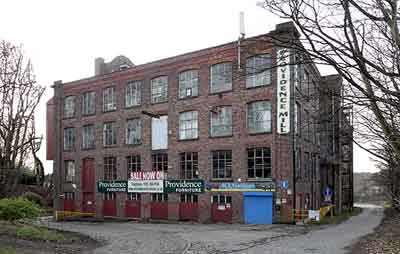
This mill is located on the west side of Alexandra St and it is bordered on the opposite side by the Lower Peak Forest Canal. Following a fire, it was rebuilt in 1886 and it was operated by Robert Walker & Sons Ltd with new machinery and electrical installations. It was the first mill in Hyde to introduce ring spinning and it housed over 40,000 spindles. It is notable for being the only complete cotton mill left standing in Hyde. Having retained its 19th-century brick architecture, it has moved away from its original purpose to become a retail area housing The Mill Furniture Outlet.
1920s–1950s: Ashton Brothers launches its famous household product lines, including Abanco fabrics and Zorbit towels.
1968: After surviving longer than almost all of its contemporary local rivals, the mills of Ashton Brothers are acquired by Courtaulds Northern Textiles Division, thus ending independent operations.
1980: Throstle Bank Mill is closed. A few years prior to closure, shuttleless looms were introduced to accelerate production and improve fabric quality.
These were water-jet looms in which a high-pressure jet of water carried the yarn across the warp.
c.1987: Throstle Bank Mill is demolished.
2008: Business ceased entirely when the dyehouse and remaining production departments on the main mill site are closed.
2008-Jun 2010: Most buildings on the main mill site are demolished.
2012-2013: The offices of Carr Field Mill and all remaining buildings are demolished.
2014: Newton Bank Print Works is demolished.
This former multi-storey cotton mill was located on the west side of Clarendon St and adjacent to it, on the opposite side, was a large mill reservoir. Moreover, it was about 165 yards due north of Hyde Town Hall on Market St. It was built in 1818 by the brothers Thomas Howard Jr and Charles Howard* who were a prominent family of early mill owners in Hyde.
Later, Long Meadow Mill was owned by a Mr Franklin Wrigley. In 1873 the Wrigley Prospectus was published with the intent to form a joint-stock company for the purpose of purchasing Long Meadow Mill from its then-owner, Mr Franklin Wrigley.
The London Gazette records that by 1882 the owners were George Schofield, James Johnson and Samuel Johnson, trading as Schofield & Johnsons. The London Gazette also records that by 1899 the owners were Louisa Schofield and Albert Ernest Broome, trading as George Schofield & Co.
By 1891 the mill was operating 27,000 spindles, producing 241/501 twist (warp) and weft cotton yarn.
The notation is first re-written as 24/1 and 50/1.
24/1 denotes 1 strand of Yarn Count Size 24s yarn and
50/1 denotes 1 strand of Yarn Count Size 50s yarn.
‘s’ stands for ‘singles’
50s yarn is a significantly thinner yarn than 24s.
These were medium-range counts that were commonly woven into standard cotton fabrics such as calicoes, shirtings, and printing cloths.
Cotton spinning eventually ceased at Long Meadow Mill and The Hippodrome, built by Wilbraham Stansfield, opened on the site in 1914. This building is still extant but it has now been converted for retail use.
The former Slack Mills complex was located on the north side of Market St near its junction with Stockport Rd and Smithy Ln. The name is derived from the Slack family, particularly Joseph Slack the Elder and Joseph Slack the Younger. The Tithe Map for 1841 shows that the earliest range of Slack Mills was directly north of the above junction and that the land surrounding it was owned by Edward Hyde Clarke and the trustees of the late Joseph Horsfield. It is possible that Joseph Horsfield was the owner of a cotton mill on the site of Slack Mills in the early years of the 19th century. The firm was styled as the Slack Mills Co and it concentrated on cotton spinning, similar to other cotton mills in the area. By 1891 the company was operating 58,892 spindles and 1,200 looms showing that it had become integrated. By 1955 the firm was manufacturing domestic linings, overall cloths, pillow cottons, sheeting, shirting and industrial cloths using American Cotton in Counts of 6s (coarse) to 32s (medium-fine) spun on ring-spinning frames.
By the mid-20th century, the cotton industry in the North-West faced a terminal decline due to overseas competition, consequently Slack Mills ceased all cotton spinning and weaving operations in 1960 and the company went into liquidation.
In the same year, 1960, the Slack Mills site was acquired by James North & Sons Ltd who transformed it into a centre for industrial safety. This company became a large producer of industrial protective equipment, famed for inventing and patenting the PVC safety glove in 1947.
As a result of their success, this company was acquired by the engineering conglomerate Siebe (later Siebe plc) in 1972. However, changing manufacturing conditions led to the closure of the site and the historic buildings of Slack Mills were demolished in Nov 1998.
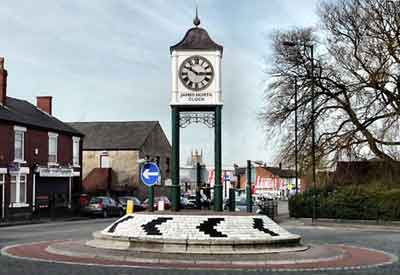
Luckily, the James North Clock, a lasting piece of the mills’ heritage remains. This factory clock was saved, restored, and built into a new, public clock tower that stands on the mini-roundabout at the junction of Market St, Stockport Rd and Smithy Ln. This landmark stands as a visual tribute to all the workers who once drove Hyde’s economy.