Tower Mill
St Helens Mill
River Mill
Tameside Mills
Queen Mill
Dukinfield Old Mill | Dukinfield Old Mill Extension
Park Road Mill
Dukinfield Hall Mill | Old Hall Mill
Bridge Eye Mill
Tower Mill
Park Rd, Dukinfield,
Tameside
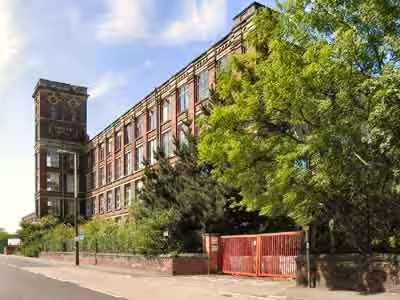
This cotton-spinning mill is located on the north side of Park Rd by the river Tame, adjacent to the junction of Park Rd and Clarence St.
It was built for Christian Valentine Koch* (1834–1895), from Switzerland, who was a prominent 19th-century industrialist and an important figure in the cotton-spinning industry of Dukinfield.
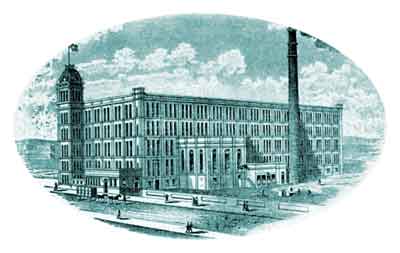
Tower Mill.
The mill was designed by Edward Potts of Potts, Pickup & Dixon of Manchester, and it opened in 1886 with 44,000 spindles.
Facing Park Rd, the mill is 4-storeys high, with a basement, by 17-bays long and it is of fireproof construction.
It is similar in design to the associated River Mill, which is also situated on Park Rd about 400 yards distant to the west, but it is more ornate.
Subsequently, the mill was worked by the River & Tower Mills Co Ltd (1912) who ceased spinning at River Mill in 1934 but
continued to work Tower Mill with spinning mule frames and ring-spinning frames until 1955 when the company went into liquidation.
River Mill.
When it was no longer used as a cotton mill it was used by various industries and divided into small units.
At one point there were plans for the mill to be converted into apartments but with the recession in 2007/08 these plans were abandoned.
The mill then lay empty until it was bought in 2013 by English Fine Cottons Ltd, refurbished and re-equipped to begin ring spinning cotton yarns again in 2016.
It was then, after an absence of 61 years, the only cotton-spinning mill in production in the UK.
The parent company of English Fine Cottons Ltd is Culimeta-Saveguard Ltd, which went into administration in March 2024 and liquidators were appointed in Sep 2024. Consequently, Tower Mill was put up for sale.
Tower Mill is Grade II listed, List Entry No. 1268070.
The function of the Tower of Tower Mill
Cotton mills normally had a tower and this one is a particularly ornate and prominent 150-foot high feature.
These towers served two key practical roles, and sometimes a third auxiliary roll, in cotton-mill design.The top of the tower was fitted with a large header tank and
water was pumped into it, either by using the mill’s main steam engine, or a small auxiliary steam engine, to drive the pump that moved water into the header tank.
Later, an electrically-powered pump would have been used.
Water storage for fire safety: Acting as a water tower, it provided the high-pressure water supply needed for the mill’s internal sprinkler system.
Cotton dust is highly combustible and it was a major fire hazard in cotton mills as it can ignite instantly from even a small spark and spread flames rapidly across the mill.
Vertical access to the mill: By incorporating a staircase and lift to provide access to every storey and basement of the mill.
Auxiliary role for mill humidity: Cotton is sensitive to the level of humidity in the air and if this is incorrect then yarn breakages will occur.
Mills sometimes used the tank to supply water to humidifiers designed to add moisture to the air to combat dryness.
St Helens Mill
Crescent Rd, Dukinfield,
Tameside
This cotton mill is located on the north-west side of Crescent Rd and it is also known as Crescent Road Mill.
The mill was a new build in 1819 by Joshua Binns (3 Apr 1817-1875) and by 1824 he had built a second range in partnership with James Dean.
The company traded as Binns, Dean, and Company and the partners were Joshua Binns, James Dean and John Binns.
The 1851 Census records that Joshua Binns was resident on Crescent Rd with his wife, Sarah Townsend, and daughter, Sarah Shaw.
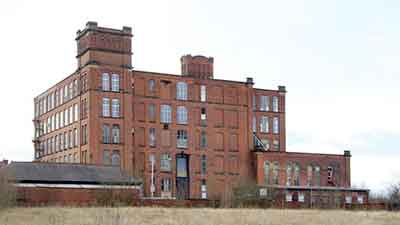
St Helens Mill viewed from Crescent Rd.
Other companies known to have worked St Helens Mill are:
Wainwright and Binns (George James Wainwright and Matthew Binns) who left in the 1850s.
Then Clementson and Leyland (Joseph Moxon Clementson and Thomas Fisher Leyland).
Then William Young & Co were the sole occupants by 1871.
The last recorded use of St Helens Mill as a cotton mill was in 1876.
The mill is of all brick construction with floors of fireproof construction supported by cylindrical cast-iron columns.
From the outset the mill was steam-powered and it is notable for being an early combined cotton mill that from the outset incorporated both spinning and weaving facilities*.
The OS 25 Inch, 1892-1914 shows a chimney in the courtyard, so it is likely that this was then the site of the boiler house.
The main spinning range faces Crescent Rd and this is 4-storeys high by 23-bays long. This was built in three phases and the central portion (bays 9 to 14) was built in 1819 and this was named, ‘New Mill’.
This makes it one of the oldest surviving cotton-mill buildings in the Tameside district. Additional buildings were in 1824, 1833-40 and 1845.
The site is complex with five ranges grouped around a triangular courtyard and smaller ranges within the courtyard.
St Helens Mill is listed Grade II, List Entry No. 1268063.
Tameside Mills
Park Rd, Dukinfield,
Tameside
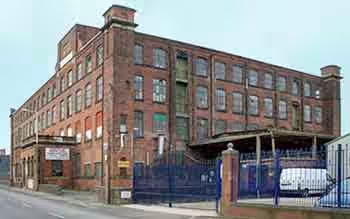
The surviving range of these cotton mills (No. 3) is situated between Tower Mill and River Mill on Park Rd and it is set back from the road by about 45 yards.
The mills were built for John and Edward Chadwick who traded as John Chadwick & Co Ltd. The main range dated from 1852 and it was 6-storeys high.
The builders were Edward Sigley & Sons of Ashton-under-Lyne, who were contractors, stonemasons, and builders.
This range was expanded in 1857, 1860 and 1872 and by 1884 the combined ranges were operating 102,000 spindles for spinning and doubling.
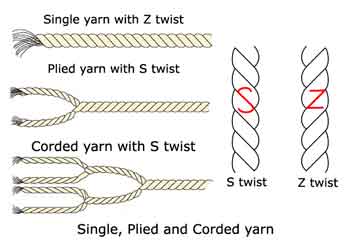
In a cotton mill, doubling is the process of combining two or more separate strands of spun yarn into a single, more uniform strand referred to as plied yarn.
To do this parallel strands of yarn are fed into a ring doubling frame or two-for-one twisting frame. In the latter, the frame makes two twists in the yarn for every one rotation of the spindle.
The purpose of doubling is that plied yarns are significantly stronger and more durable than single yarns and they are smoother.
Corded or cabled yarn is a strong, multi-layered yarn made by twisting two or more plied yarns together.
In 1884 the final range, designated No. 3, was built and the architects were Potts, Son & Pickup based in Manchester and Oldham.
The front of this range, facing Park Rd, is 4-storeys high by 11-bays wide.
No. 3 range of Tameside Mills.
By 1920 there were 115,596 mule spindles, 14,108 ring-spinning spindles and 10,240 doubling spindles. Tameside Mills closed in 1933 and all the ranges, with the exception of No. 3, were demolished.
By 1933, the Lancashire cotton industry was in a severe depression caused by global competition that resulted in bankruptcies. Between 1931 and 1933, over 100 mills closed in Lancashire.
The industry saw falling exports and structural decline, leading to rationalisation efforts like the Lancashire Cotton Corporation founded by the Bank of England in 1929.
Two of the earliest cotton-spinning companies to be sold to the Lancashire Cotton Corporation were Bolton Union Spinning Co (1920) Ltd of Halliwell, Bolton, and Royd Mill (1919 ) Ltd of Hollinwood, Oldham, both in Jan 1930.
Queen Mill
Foundry St, Dukinfield,
Tameside
This former cotton mill was located on the north side of Foundry St between Wild St and Oxford Mills (53.4773, -2.0814).
It was built of red engineering brick in 1901/02 for Queen Mill (Dukinfield) Ltd and it was the last mill to be built in Dukinfield. In 1954 it was acquired by Fine Spinners and Doublers Ltd.
The company was also a member of The Federation of Master Cotton Spinners' Association Ltd. In 1963 it was acquired by Courtaulds Northern Textiles Division but shortly afterwards the mill ceased cotton production.
The mill then became part of the Sterling Moulding Materials Group (later, Sterling Mouldings). Sterling Mouldings ceased production at Queen Mill by 1983/84 and the mill was demolished at this time.
Queen Mill.
The architect for the design of Queen Mill was the renowned Sir Philip Sidney Stott of Oldham and the contractors were Messrs Storrs & Son, of Stalybridge.
It was 4-storeys by 33-bays long built of red engineering brick and a notable feature was the water tower crowned by a cupola.
When the mill opened it had 101,608 mule spindles for the production of 36/54s count velvet weft and American cotton twist (warp) of 36/50s count.
When woven, these yarns would have resulted in a medium thickness velvet fabric.
Dukinfield Old Mill Extension
Park Rd, Dukinfield,
Tameside
The former Dukinfield Old Mill Extension was located on the north side of Park Rd, about 775 yards to the west of the junction of Park Rd with Sandy Ln and Clarence St.
It was built of red engineering brick in 1894/95 for the Old Mill Co (Dukinfield) Ltd and at the time it was officially described as the Extension of Dukinfield Old Mill when it was really a replacement.
The architect for the design of Dukinfield Old Mill Extension was the renowned Sir Philip Sidney Stott of Oldham.
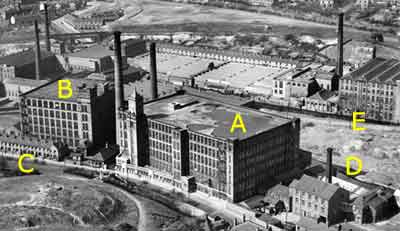
Dukinfield Old Mill Extension viewed looking west. The engine house is on the right and Park Rd is off the picture on the left.
There is a portion of glassed-in diagonal rope race above the left-hand end of the engine house roof and to its left there is a series of blind windows in the mill.
These mark where the rope race and driving pulleys for the mill were housed. The open area in the foreground is where Park Road Mill (built 1891/93) once stood but this was demolished in 1995.
The first mill to be built on this site was Dukinfield Old Mill (53.48241, -2.08465) †. It was founded in 1792 and it was one of the first two cotton-spinning mills built in Dukinfield.
Together with the neighbouring Furnace Mill (53.48333, -2.09277), it marked the beginning of the town's industrial transformation.
The mill was significantly expanded in the 1810s and 1820s and by 1839 the mill was being managed by the prominent industrialists, Samuel Robinson and Cyrus Armitage, trading under the style of Robinson & Armitage.
In 1877 the London Gazette recorded that the partners in the Old Mill Co were John Camenisch‡, Lewis Lloyd and Harold Cunningham.
After the Dukinfield Old Mill Extension was built in 1894/95 the earlier buildings were eventually demolished.
The London Gazette records that the Old Mill Co (Dukinfield) Ltd went into liquidation in 1952 and it was around this time that cotton spinning ceased at the mill.
After cotton spinning ceased the mill transitioned through several industrial and commercial uses.
In Feb 2014 the mill was badly damaged during storms and it was declared structurally unsafe and demolished later that year.
Park Road Mill
Dukinfield, Tameside
The former Park Road Mill was located on the north side of Park Rd, directly to the east of Dukinfield Old Miil Extension, and about 645 yards to the west of the junction of Park Rd with Sandy Ln and Clarence St (53.48231, -2.08339).
It was 5-storeys, built of red engineering brick in 1891/92 for the Park Road Spinning Co Ltd. It was associated with the Astley Mill Co Ltd, having the same directors.
The architects were A H Stott & Sons of King St, Oldham, and Haworth Buildings, Cross Street, Manchester, and the contractors were Messrs E Taylor & Co of Littleborough.
A: Park Road Mill
B: Dukinfield Old Mill Extension
C: Park Rd
D: River Tame
E: Huddersfield Narrow Canal
When it opened, the mill contained 38 pairs of spinning mule frames with 92,280 spindles. The 96 carding engines were provided by Asa Lees & Co of the Soho Iron Works, Huddersfield Rd, Oldham.
Park Road Mill specialised in spinning twists (warp) and weft in coarse counts using American cotton. By 1950 ring spinning had been introduced and by 1961 there were 27,864 ring spindles.
Some mule spinning continued but the number of mule spindles had reduced to 17,664.
Power was provided by a pair of horizontal cross-compound triple-expansion steam engines provided by B Goodfellow & Co of Mottram Rd, Hyde.
They delivered 1,500 IHP* to the shafts via a 30-feet diameter flywheel grooved for 45 drive ropes.
By 1955 Park Road Mill was spinning cotton and rayon yarn in the following counts:
12s to 24s twist (warp) and weft, American cotton, using spinning-mule frames.
12s to 30s twist (warp) and weft, Egyptian cotton, using spinning-mule frames.
10s to 24s warp and weft, American cotton, using ring-spinning frames.
10s to 28s warp and weft, Egyptian cotton, using ring-spinning frames.
8s to 32s warp and weft rayon.
Egyptian cotton has extra-long staple fibres when compared with American cotton, which allow for the spinning of incredibly fine, yet strong yarns.
Short-staple fibre is under 1.1 inches long.
Long-staple is 1.1 to 1.4 inches long.
Extra-long staple is over 1.4 inches long.
Rayon is a semi-synthetic fibre composed of regenerated cellulose, generally derived from wood pulp. It can be produced using any plant, such as bamboo, eucalyptus, pine and spruce.
Once this pulp is made, it goes through various steps of chemical treatments, before finally being spun into a yarn and then woven into fabric.
In 1964 cotton spinning ceased and the Park Road Spinning Co Ltd was liquidated.
Subsequently, the building was used for a while by ICL Computers Ltd, alongside their manufacturing hub in West Gorton, Manchester, but this was closed and the mill was demolished in Aug 1995.
Dukinfield Hall Mill
Wellbridge Rd, off Globe Ln, Dukinfield,
Tameside
The first mill to be built on this site off the west side of Wellbridge Rd
was Dukinfield Hall Mill and the London Gazette records that by 1833 Abel Buckley Wimpenny, William Swindells and Joel Gee were working a cotton-spinning mill there.
This company was succeeded by Hindley and Sutcliffe (Frederick Hindley and William Henry Sutcliffe) and after 1851 by C F Hindley & Co (Charles Frederick Hindley).
Around this time 36 count of twist (warp) and weft were being spun. This means that a balanced fine cloth could be woven with the twist (warp) and weft being the same.
By 1868 the Dukinfield Hall Spinning Co was in occupation of the mill and in 1872 this company was incorporated as the Dukinfield Hall Spinning Co Ltd.
At this time the company was operating 40,236 spindles of 32/54 counts, producing 23,000 pounds of yarn per week. 32/54 refers to the fabric density per square inch, that is, 32 threads in the warp and 54 threads in the weft.
By 1891 the company was operating 44,064 mule spindles of 321/408 twist (warp) and 401/528 weft. These reference numbers indicate the range of yarns that the mill could spin.
The Dukinfield Hall Spinning Co Ltd was wound up in 1894 and the mill was demolished in 1895.
Old Hall Mill
Wellbridge Rd, off Globe Ln, Dukinfield,
Tameside
The weaving shed of this mill was built in the locale of Dukinfield Hall Mill off the west side of Wellbridge Rd (53.46917, -2.09965).
It was bounded to the north by Dukinfield Hall and to the south by the Lower Peak Forest Canal.
The shed was built speculatively after the end of the Cotton Famine in 1865 and it was occupied between 1871 and 1874 by William Young & Co and then by Henry Bannerman & Sons Ltd.
The latter company was based on York St, Manchester, and it also owned River Meadow Mill and North End Mill in Stalybridge besides Brunswick Mill on Bradford Rd, Ancoats, Manchester.
Brunswick Mill is listed Grade II, List Entry No. 1197807.
On opening, Old Hall Mill had 200 looms but the shed was then expanded and by 1884 it had 300 looms. When a devastating fire occurred in 1906 it had 550 looms.
Drawing of Old Hall Mill. The weaving shed is positioned on a bearing of N 32° E and the front is facing Dukinfield Hall,
which is visible on the right.
After the fire the weaving shed was completely rebuilt to a design by the renowned architect, Sir Philip Sidney Stott of Oldham.
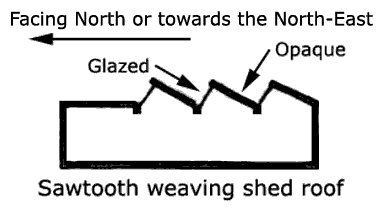
The new shed was about 155-feet wide by 125-feet long and it was positioned so that the sawtooth or north-light roof across the width of the building was on a bearing of N 32° E.
The steeper side of each tooth was glazed while the shallow side was covered with an opaque material to shield the interior from the sun.
This ensured consistent good-quality light needed inside for the weavers operating the looms.
In 1930 the Old Hall Mill was acquired by the Lancashire Cotton Corporation Ltd but shortly afterwards it was decommissioned and it closed in 1933.
Bridge Eye Mill
Furnace St, Dukinfield,
Tameside
This mill was located off the north side of Furnace St, near Cresent Rd (53.48454, -2.09204).
It derived its name from its geographic position inside a loop of the river Tame, historically referred to as the ‘Bridge Eye’.
Its origins were in 1792 when the water-powered Furnace Mill opened on the site. In 1815 the cotton master, Robert Lees, constructed the first part of what became known as Bridge Eye Mill.
Over the next decade Robert Lees gradually expanded the site in 1822, 1823, and 1827. By 1833 the mill was powered by three steam engines, two rated at 50 IHP and one at 36 IHP.
By 1833 Bridge Eye Mill was fully integrated in spinning and weaving, employing 1,134 workers. Of these, 487 were spinning high-quality 40 to 60 counts of yarn (often written as 40s to 60s),
while the others operated the weaving looms. These cotton counts indicate that the spun yarn was of a fine, lightweight quality.
Together with Walk Mill in nearby Ashton-under-Lyne, which was built by Robert Lees' sons, John and Joseph, the family's textile operations provided employment for over 1,500 local residents.
Walk Mill was about ½-mile distant from Bridge Eye Mill to the south west.
Like other early mills in Tameside, changing economic circumstances and the need for more modern mill architecture caused operations to slow down at Bridge Eye Mill towards the late 19th century.
In 1847 it was recorded that weaving operations were still active but in 1884 all textile production ceased and the mill was closed. In 1910, after standing vacant, the historic Bridge Eye Mill was demolished.