
St Mark's Church St Luke's Church Church of St John the Evangelist
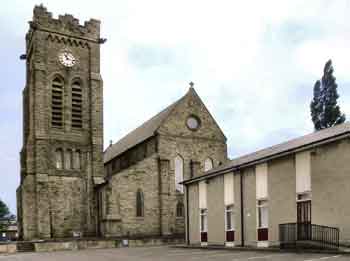
St Mark’s Church viewed looking east from Railway St.
The building on the right is the church hall which opened in 1984.
 This Anglican church was built in 1848-49 and the architect was Joseph Clarke (1819-1888) of London on behalf of the Church Commissioners.
It was built in stone with a slate roof following the formation of the new Parish of St Mark, Dukinfield.
The tower was added in 1880-81 and the architect was Col John Eaton Jr (1838-25 Nov 1905) of John Eaton & Sons whose architectural practice was at Ashton-under-Lyne.
He was responsible for two other commissions in Dukinfield, namely the nearby St Luke’s Church and Dukinfield Town Hall, both of which are on King St.
John Eaton was the Lieutenant Colonel and Honorary Colonel of the 3rd Volunteer Battalion of the Manchester Regiment (Ashton Volunteers).
This Anglican church was built in 1848-49 and the architect was Joseph Clarke (1819-1888) of London on behalf of the Church Commissioners.
It was built in stone with a slate roof following the formation of the new Parish of St Mark, Dukinfield.
The tower was added in 1880-81 and the architect was Col John Eaton Jr (1838-25 Nov 1905) of John Eaton & Sons whose architectural practice was at Ashton-under-Lyne.
He was responsible for two other commissions in Dukinfield, namely the nearby St Luke’s Church and Dukinfield Town Hall, both of which are on King St.
John Eaton was the Lieutenant Colonel and Honorary Colonel of the 3rd Volunteer Battalion of the Manchester Regiment (Ashton Volunteers).
St Mark's Church is listed Grade II, List Entry No. 1356419.
A life-long member of St Mark’s Church was the actress Kathy Staff and a blue plaque dedicated to her is fixed on the wall of the Church Hall. She was best known for her role as Nora Batty in 'Last of the Summer Wine'. Kathy Staff was born at Dukinfield as Minnie Higginbottom and she started her acting career as Katherine Brant. She married John William Staff at St Mark’s Church in 1951.
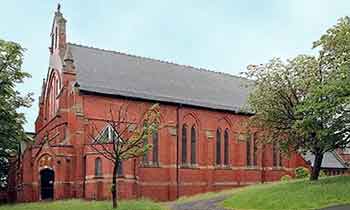
St Luke's Church.
 This Anglican church is on the east side of King St and it opened in 1889.
However, the 1881 census records that the curate of St Luke’s was the Revd William Quibell who was resident on Old Rd, Dukinfield.
This indicates that the present church is the second Dukinfield church with this name.
Revd William Quibell was born at Hull, Yorkshire, in 1857 and he married Louisa Wileman at Lincoln in 1883. By 1891 he was a rector at Keele, Staffordshire. He died at Lincoln on the 9 Oct 1940.
This Anglican church is on the east side of King St and it opened in 1889.
However, the 1881 census records that the curate of St Luke’s was the Revd William Quibell who was resident on Old Rd, Dukinfield.
This indicates that the present church is the second Dukinfield church with this name.
Revd William Quibell was born at Hull, Yorkshire, in 1857 and he married Louisa Wileman at Lincoln in 1883. By 1891 he was a rector at Keele, Staffordshire. He died at Lincoln on the 9 Oct 1940.
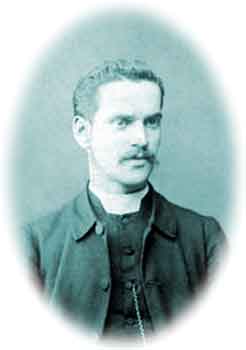
Revd William Quibell.
St Luke's Church is closed and it is listed Grade II, List Entry No. 1084304.
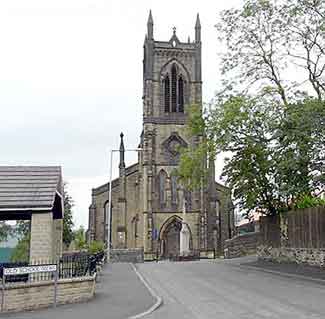
This Anglican church was built in 1838-41 and
the architect was Edmund Sharpe (1809-1877) of Lancaster on behalf of the Church Commissioners.
Edmund Sharpe was born at Knutsford, Cheshire, but in 1824 he moved with his mother and sister to live at Lancaster.
The foundation stone was laid on the 3 Sep 1838 and the church was consecrated on the 24 May 1841 by the Bishop of Chester, the Rt Revd John Bird Sumner.
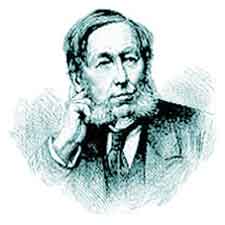
Edmund Sharpe.
The church is built of stone with a slate roof and it stands on the south side of High St in an elevated position at the top of a low hill.
It is listed Grade II, List Entry No. 1068017.
Revd Joseph Rayner Stephens (1805/79)
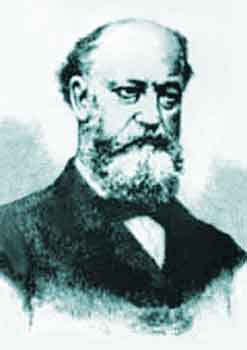
Revd Joseph Rayner Stephens.
The churchyard of St John’s Church is the burial place of the 19th century reformer, the Revd Joseph Rayner Stephens who died at his home on Cheetham Hill Rd, Dukinfield, in 1879. He was born in Edinburgh and was trained in the Ministry. He was continually aware of social injustice and human suffering and when he came to Ashton-under-Lyne in 1832 he became an influential member of the Chartist Movement and campaigned for factory reform and against the New Poor Law. This was introduced in 1834 and in 1929 it was notionally abolished but it was not until 1948 that the New Poor Law system was finally abolished.
Later, he moved to Stalybridge and in 1841 he founded a People’s School for adult education on Astley St, Stalybridge. Later, the building became the Holy Trinity Mission Hall. The original chapel interior from the mission hall is now on display at Portland Basin Museum, Ashton-under-Lyne.
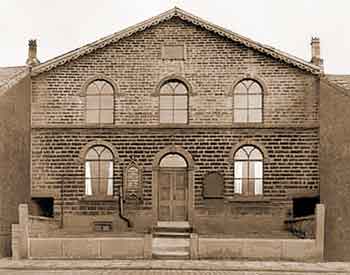
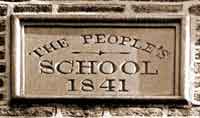
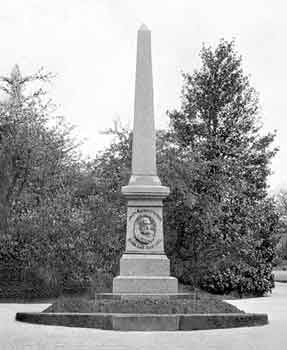
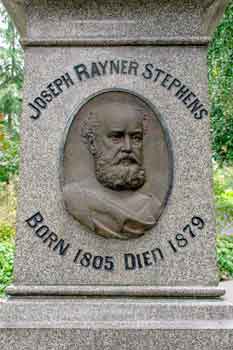
In 1888 an obelisk commemorating Joseph Rayner Stephens was erected in Stamford Park, Stalybridge, and there is also a blue plaque commemorating him on the Waterloo Rd/Trinity St portico of the former Stalybridge Town Hall*. He is also remembered by Rayner Stephens High School on Yew Tree Ln, Dukinfield.
Granite memorial obelisk with a bronze relief portrait of the Revd Joseph Rayner Stephens
This obelisk is located in Stamford Park, Stalybridge.
Blue plaque commemorating the Revd Joseph Rayner Stephens
This plaque is located on the left-hand side of the portico of the former Stalybridge Town Hall.
The Cotton Tree Inn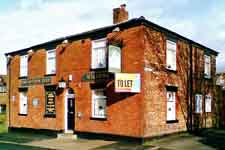 on the Whitnall St corner of Markham St, Newton, Hyde, was used by the Chartist Movement to hold meetings.
One such meeting was held there on the 28 Jul 1839 and as a consequence
the Revd Joseph Rayner Stephens and two associates, Dr Paul Murray McDouall
on the Whitnall St corner of Markham St, Newton, Hyde, was used by the Chartist Movement to hold meetings.
One such meeting was held there on the 28 Jul 1839 and as a consequence
the Revd Joseph Rayner Stephens and two associates, Dr Paul Murray McDouall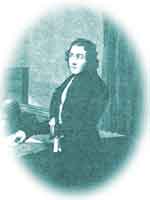 * and John Bradley, were arrested.
They were charged with attending an unlawful meeting, sedition and disturbing the peace and were convicted and sentenced to 18-months imprisonment in Chester Castle.
* and John Bradley, were arrested.
They were charged with attending an unlawful meeting, sedition and disturbing the peace and were convicted and sentenced to 18-months imprisonment in Chester Castle.
The Cotton Tree Inn opened in 1830 and it was so named because its opening coincided with the opening of cotton mills in the Newton area by Ashton Brothers. It closed in 2012.
