
Edge Lane Mill Saxon Mill Marchington's Beetle Works Albion Mill Oakfield Mill Royal Mill Lumb Mill
The former Edge Lane Mill was located off the east side of Edge Lane, beside the Ashton Canal just above Edge Lane Lock (Lock 16). It dates from 1891 and the architects were A H Stott & Sons of Oldham and Manchester. The original owners were John Fletcher and Sons, who also owned Birch Mills at the bottom of Pottinger St, Ashton-under-Lyne. At this time the mill was operating 41,640 spindles.
In the late 1890s the building was acquired by Bowker & Ball Ltd who also owned Crescent Mill (aka Bow Mill), on Crescent Rd, Dukinfield. Confusingly, they also knew Edge Lane Mill as Crescent Mill. At some point, the building was then acquired by the Edge Lane Mills Co Ltd and the London Gazette records that this company went into liquidation in 1918. Around this time ownership then passed to The Patent Knitting Co Ltd who occupied the building until the 1970s. This company was a textile manufacturer, well known for manufacturing towels and car seat covers. The next occupier was Johnstone’s Paints who used the building for paint storage. In 1981 Edge Lane Mill was destroyed by a massive fire while the building was still being used by Johnstone's Paints.
This former cotton-spinning mill was located on the north side of Medlock St, with Saxon St to the east and the Hollinwood Branch Canal to the west. It was bordered to the north by Oakfield Mill (John Broadbent & Sons) and to the south by Albion Mill (Joseph Byrom & Sons). The only reminders of its former existence are the mill reservoir and Saxon St.
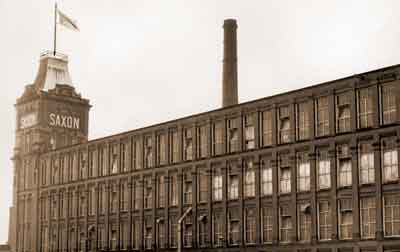
This was a large four-storey fireproof mill with a basement, 18-bays long by 14-bays wide, built of red engineering brick with some sandstone detailing and it had a flat roof, tanked to collect water. A notable feature was the 'Hotel-de-Ville' style water tower. It was constructed as a grid of cast-iron I-beams. The transverse beams were supported on cast-iron columns, supporting the longitudinal beams that in turn supported shallow brick vaults. These ran the entire length of the mill, making fireproof ceilings and floors. The basement was used to condition cotton and the ground floor contained cotton-preparation machines. The top three floors contained ring-spinning machines. In 1908 the mill had 80,000 spindles that rose to 82,000 by 1920. Supplies of raw cotton and coal for the boilers would have been via the adjacent Hollinwood Branch Canal.
It was built as a replacement for an earlier mill on the site and it opened in 1907 for the Saxon Mill Co Ltd, a member of the Ashton Syndicate (the Minerva Spinning Co Ltd was the founding member), which was a consortium of investors and directors that financed and built major cotton-spinning mills in the Tameside area during the late 19th and early 20th centuries. Local cotton mills financed by the syndicate included:
The architect for the design of these mills was the renowned Sir Philip Sidney Stott, 1st Baronet (1858-1937) of Oldham.
During the 1920s the Lancashire cotton industry began to experience severe depression and, as a consequence, in the early 1930s the Saxon Mill Co Ltd was sold to the Lancashire Cotton Corporation. In 1964 Courtaulds Northern Textiles Division acquired Lancashire Cotton Corporation, hence Courtaulds were then working Saxon Mill. Courtaulds ended cotton spinning at Saxon Mill in 1967 and it was demolished in 1995 for the site to be developed for housing.
Cotton Mills adjacent to the Hollinwood Branch Canal in Droylsden
This former textile finishing works was located between Hampson St and the Hollinwood Branch Canal and it was directly south of Albion Mill. It was owned by Thomas Edward Marchington and the firm was styled T E Marchington & Co Ltd. The Canal Distance Table for Sep 1888 records that this works was extant by this time.
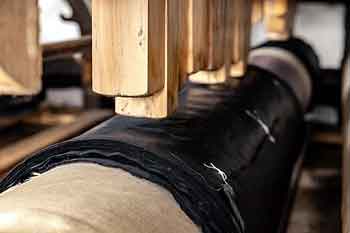
It was a business of textile bleachers, dyers, and finishers that specialised in the ‘beetling’ process, that involved using heavy wooden hammers (beetles) to continuously strike damp woven fabric. The pounding flattened the cotton threads, closing up the weave to give the material a smooth, high-lustre, and leather-like sheen.
This firm was able to adapt to changing market conditions that enabled it to survive well into the 20th century and it did this by developing the ability to process modern synthetic textiles such as rayon, acrylic rayon, nylon, polyester and acrylic. For example, it is understood that in 1932 the firm obtained a licence, by paying royalties to the American patent holder, that enabled them to use a production process called 'color discharge printing' that created coloured patterns on fabrics such as rayon. This allowed them to apply highly durable colours to rayon for dress wear and home furnishings.
Eventually the firm succumbed to the steep decline in the Lancashire textile industry in the mid-20th century, the beetle works closed down and was demolished to make way for housing development.
This former mill was located on the south side of Medlock St beside the Hollingworth Branch Canal. The Canal Distance Table for Sep 1888 records that this mill was extant by this time.
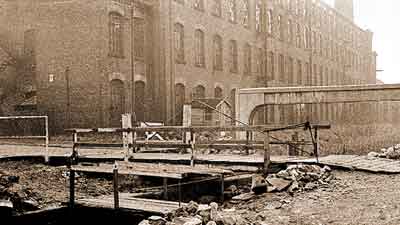
Albion Mill was owned by Joseph Byrom and Sons, (later Robert Byrom (Stalybridge) Ltd) who were a prominent textile manufacturing family who also owned the nearby Victoria Mill and Royal Mill. The mill had 22,548 spindles producing 16s/24s and 4s/24s extra hard twist*.
In 1932 the London Gazette recorded that Joseph Byrom and Sons was in liquidation and in 1960 that the successor company, Robert Byrom (Stalybridge) Ltd, was in liquidation. Consequently, textile production at Albion Mill ceased in 1960 and it was demolished sometime after 1964.
This former mill was located off the north side of Medlock St, and was accessed via Saxon St. It was beside the Hollinwood Branch Canal, directly north of Saxon Mill. It dated from 1877, the architects were A H Stott & Sons of Oldham and Manchester, and the original owners were John Broadbent and Sons.
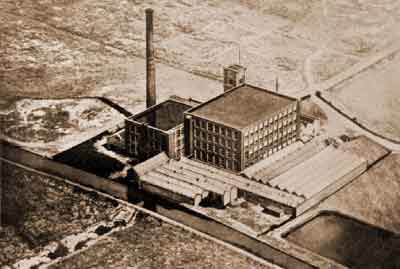
By 1896 the mill had 24,000 spindles powered by a steam engine built by Woolstenhulmes, Rye, & Co Ltd of the Lower Moor Ironworks, Oldham. In 1953 the steam engine was converted into a 900 HP twin tandem compound steam engine by Thomas Wainwright & Sons of the Commercial Iron Works, Canal St, Stalybridge.
At some point after WWII Oakfield Mill was occupied by Lintafoam Ltd, a manufacturer of plastic foam, rubber backings, and synthetic textiles. The mill was demolished sometime between the late 1970s and 1980s.
This former mill was located on Newton St off the west side of Moorside St. It was beside the Hollinwood Branch Canal and near the local railway line.
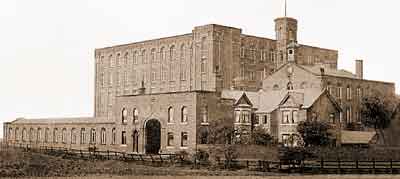
The mill was owned by Joseph Byrom and Sons who were a prominent textile manufacturing family who also owned the nearby Albion Mill and Victoria Mill*. The Canal Distance Table for Sep 1888 records that this mill was extant by this time. In 1914 the London Gazette recorded that the family members in the company were; William Byrom, Charles Alfred Byrom, George Frederick Byrom, Arthur Byrom, and George Harry Byrom. The mill had 45,000 spindles producing 28s/32s twist yarn. In 1932 the London Gazette recorded that this company was in liquidation.
Following the decline of the Lancashire cotton industry in the mid-20th century, Royal Mill eventually ceased textile production and was adapted for other commercial uses. In 1966, the transport company, Geoffrey Reyner Ltd, moved its operations into Royal Mill. The building served as the company's main warehousing, logistics, and garage centre until 2001. The company then moved to Earl Mill on Dowry St, Oldham, now known as the Earl Business Centre. Following the departure of Geoffrey Reyner Ltd, the Royal Mill buildings were completely cleared and demolished.
This former mill was located between Lumb Ln and the Hollinwood Branch Canal. The Canal Distance Table for Sep 1888 records that this mill was extant by this time and it was under the ownership of the Cryer Brothers (John Bottomley Cryer, Walker Cryer and Ben Cryer). At this time, the mill had 45,000 spindles producing 28s/32s and 36s/40s twist yarn. In 1903 the mill was acquired by the Fine Cotton Spinners and Doublers Association (from 1946 known as the Fine Spinners & Doublers Ltd). In 1962, as a result of the decline in the Lancashire textile industry, Fine Spinners & Doublers Ltd announced the closure of the mill.
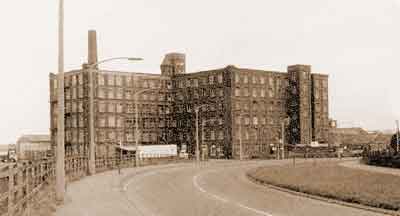
In 1963 the building was taken over by Sharna-Ware Ltd, a prominent plastic products company. The building was converted into injection moulding and power press workrooms to manufacture domestic household items. In 1983 Sharna-Ware Ltd purchased the iconic Tri-ang Toys (brand name of Lines Bros Ltd; three Line brothers making a triangle) and the former mill became well-known for producing a wide variety of toys, including scale model vehicles and railways. Their toy range spanned the use of metal, plastic, wood, and electronics. In 1989, following heavy financial losses, operations at the former mill ceased. The building then lay empty until it was demolished in 1991, exactly 100 years after it originally opened.
