
Cedar Mill Curzon Mill Rock Mill Texas Mill ------- Ashton Mill
Introduction
The building of the first four cotton-spinning mills was financed by the Ashton Syndicate (the Minerva Spinning Co Ltd was the founding member).
In 1921 the Ashton Syndicate was re-floated as the Atlas Mills Group (Atlas Mills Ltd). The architect for their design was the renowned Sir Philip Sidney Stott of Oldham.
The boiler-house chimneys featured Stott’s trademark, two rings near the top.
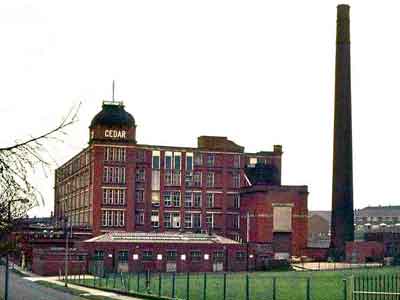
This mill was built of red engineering brick in 1903/05 for the Cedar Mill Co Ltd and the contractors were J Partington & Sons of Middleton Junction, Middleton/Chadderton. The water tower was of a French-influenced design. The triple-expansion steam engine was built by George Saxon & Co Ltd of Openshaw, Manchester. At startup there were 77,184 spindles using mule frames. In 1921 it was re-floated under Atlas Mills Ltd and in 1933 it became part of the Lancashire Cotton Corporation (LCC). In 1934 extensions were made to the mill. In 1964 it was acquired into Courtaulds Northern Textiles Division following its acquisition of LCC. The mill continued working throughout the 1970s and production ceased in Mar 1980. Subsequently, it was divided into multiple unit occupation from 1982 until 1984. In 1988 the mill was demolished and the site was redeveloped for housing.
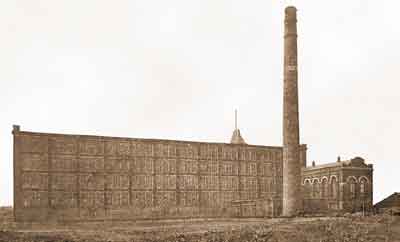
This mill was built of red engineering brick in 1899/1902 for the Curzon Mill Company Ltd and the contractors were J Partington & Sons of Middleton Junction, Middleton/Chadderton. A notable feature was the 'Hotel-de-Ville' style water tower. The triple-expansion steam engine was built by George Saxon & Co Ltd of Openshaw, Manchester. The mule frames were provided by John Hetherington & Sons Ltd of Vulcan Works, Pollard St, Ancoats, Manchester. At startup there were 77,184 spindles. In 1911 the mill was sold to the Alger Spinning Co Ltd, at which time it was renamed Alger Mill. In 1941/42 the Alger Spinning Co Ltd was liquidated and the mill was repurposed. In 1968 the mill was sold to Qualitex Yarns Ltd for the production of artificial fibres and this company was active there until the early 1990s. The mill was demolished in 1994.
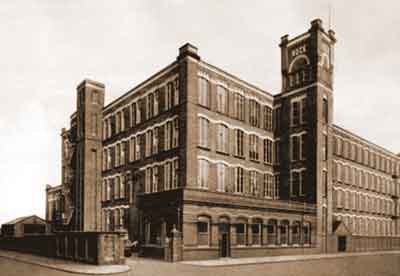
This mill, in the Waterloo District of Ashton, was built of red engineering brick in 1891/93 for the Rock Mill Spinning Co Ltd on the site of the earlier Wilshaw Mill and uniquely the boiler-house octagonal chimney of this mill was saved to become the chimney for the new boiler house. The contactors were E & J Smethurst of Oldham. The triple-expansion steam engine was built by George Saxon & Co Ltd of Openshaw, Manchester. At startup there were 66,000 spindles using mule frames. In 1921 it was re-floated under Atlas Mills Ltd and in 1929 it became part of the Lancashire Cotton Corporation (LCC). In 1964 it was acquired into Courtaulds Northern Textiles Division following its acquisition of LCC. The mill ceased spinning in the 1960s and was briefly used as a warehouse before being demolished in 1971.
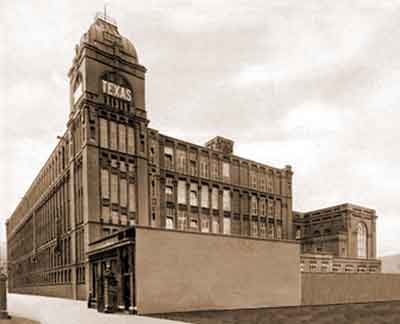
This mill, in the Whitelands District of Ashton, was built of red engineering brick in 1905/07 for the Texas Mill Co Ltd and the contractors were J Partington & Sons of Middleton Junction, Middleton/Chadderton. A notable feature was the 'Hotel-de-Ville' style water tower. The triple-expansion steam engine was built by George Saxon & Co Ltd of Openshaw, Manchester. The mule frames were provided by John Hetherington & Sons Ltd of Vulcan Works, Pollard St, Ancoats, Manchester. At startup there were 76,896 spindles. By 1948 the mill had been re-equipped with 35,000 ring spindles. At some point Texas Mill switched to spinning artificial fibres. In 1921 it was re-floated under Atlas Mills Ltd and in 1929 it became part of the Lancashire Cotton Corporation (LCC). In 1964 it was acquired into Courtaulds Northern Textiles Division following its acquisition of LCC. The mill was destroyed by fire on the 22/23 Oct 1971.
Ashton Mill was located on the right bank of the river Tame, off the west side of Cavendish St (at or near 53.48327, -2.09668). Originally, it was a manorial corn mill water powered by two 15-foot diameter waterwheels. The weir in the river Tame that supplied the head of water to the mill was sited about 250 yards upstream and the mill race or leat, across a loop in the river, was about 200-yards long. Although the mill was originally water powered, there are no records of it being converted to steam power but it is likely that at some point it was converted.
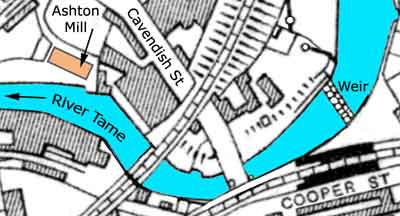
In the early days of the Industrial Revolution, it was repurposed as a water-powered cotton mill, initially operating as a carding mill to process raw cotton. A carding machine is used to disentangle and intermix the fibres of raw cotton to produce an aligned sheet of wadding suitable for eventual spinning into yarn.
As textile manufacturing increased in Lancashire between 1788 and 1803, the site underwent significant expansion and in 1788 the mill was rebuilt on the site and the new building was about 20-yards long by 8-yards wide. By 1803 the mill had fully evolved for complete cotton production. It contained modern machinery of the day for carding, drawing, roving, and spinning cotton into yarn. Drawing improves the uniformity and parallel alignment of the fibre. Roving reduces the thickness and inserts a slight twist. The output from roving machines are called ‘slivers’. The mill notably incorporated mule, throstle, and water-frames to automate the spinning process. In 1848 the physical structure of the mill was partially rebuilt to improve its efficiency still further. During the early Victorian Era, the mill was able to adapt to keep up with shifting economic circumstances. In c.1874, the mill was briefly occupied by a joint-stock company known as The Manorial Spinning Co Ltd but afterwards there are no records of other occupiers.
Like many older mills, it was eventually unable to fully adapt to economic changes and advances in textile technology. It faced increased competition from larger, purpose-built steam-powered mills. Consequently, in 1892 Ashton Mill ceased all operations and closed.
