During the 19th century, the heavy concentration of cotton mills across the towns of what is now Tameside gave rise to a highly specialised local engineering and machine-making sector. The district hosted two prominent manufacturing firms and innovators that supported the growing local cotton industry. It did this in the face of competition from the neighbouring Oldham and Manchester.
This firm was located off the north side of Grosvenor St/Acres Ln and on the opposite side it was bordered by the Huddersfield Narrow Canal (53.48227, -2.05422).
It was established in 1852 as a tradesmen's co-operative consisting of 23 original partners and in its early days it came to be locally known as ‘The Amalgamated Shop’. The names of three prominent partners were James Taylor, John Lang and James Uttley. Eventually, it developed into a major employer in Stalybridge.
It became renowned for its self-acting spinning mule frames and raw-cotton cleaning machinery, particularly bale openers and hopper feeders. It also manufactured machinery for spinning wool. For instance, Taylor, Lang & Co installed spinning-mule frames in Astley Mill and Queen Mill in Dukinfield and Castle Mill in Stalybridge. Additionally, their specialised fitters regularly travelled abroad to install machinery across Europe, United States, India and South Africa.
In the 1930s the firm integrated into the Textile Machinery Makers Ltd (TMM) cartel. This was formed in 1931 as a cartel of British textile machine manufacturers to combat severe industry overcapacity and plunging prices during the Great Depression. By consolidating power, the cartel stabilised prices, closed excess factories, and amicably divided market segments among former competitors.
This firm was located at the northern end of Canal St and the opposite side bordered the Huddersfield Narrow Canal. It spanned a strip of land on either side of Canal St (53.48207, -2.05924).
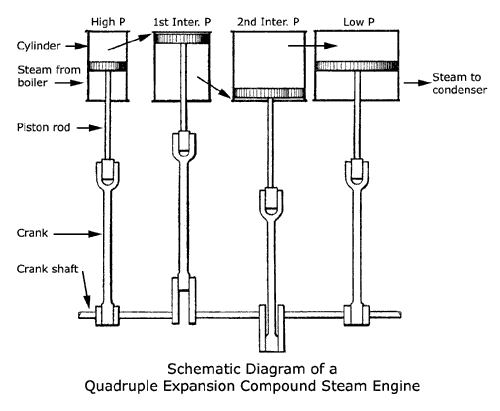
It specialised in the manufacture of powerful steam engines that were required to drive large configurations of thousands of spinning spindles. This work included shafting and mill gearing. Moreover, it co-operated with regional textile companies by repairing, reconfiguring, and upgrading mill engines to handle greater power outputs as automation expanded late in the 19th century. For instance, in 1953 the steam engine at Oakfield Mill in Droylsden was upgraded by Thomas Wainwright & Sons into a 900 HP twin tandem compound steam engine.
The advent of steam engines completely changed 19th-century cotton mills by replacing unreliable waterwheels with constant, coal-powered energy. This shift allowed mill owners to build mills inside towns rather than always beside rivers. Prior to the arrival of steam engines, early cotton mills relied entirely on waterpower to turn their waterwheels. This created major problems for mill owners. Mills had to close or slow down during summer droughts or winter freezes and too many mills on the same river caused water shortages.
From 1900 onwards the typical power range of steam engines in the Lancashire cotton industry was from 300 to 2,500 IHP. The precise power needed depended upon whether the mill was used for weaving cloth or spinning raw cotton into yarn. For mills solely with weaving sheds the range was from 300 to 600 IHP and for mills used solely for spinning cotton into yarn it was from 1,000 to 2,500 IHP. The range becomes more convoluted when a mill was fully integrated, that is, doing both spinning and weaving. Moreover, for some of the very large cotton-spinning mills the range could be from 3,000 to 4,000 IHP.
To convert horse power to kilowatts multiply the power value by 0.7457.
| Mill | Type of Steam Engine | Maker |
|---|---|---|
| Cedar Mill, Ashton-u-Lyne. | One 1,500 IHP vertical triple-expansion compound engine. | George Saxon & Co, Openshaw Engineering Works, South St, Openshaw. |
| Rock Mill, Ashton-u-Lyne. | One 1,250 IHP twin tandem triple-expansion compound engine. | George Saxon & Co. |
| Texas Mill, Ashton-u-Lyne. | One 1,500 IHP vertical triple-expansion compound engine. | George Saxon & Co. |
| Tudor, Ashton-u-Lyne. | One 1,800 IHP vertical triple-expansion compound engine. | George Saxon & Co. |
| Albert Mill, Dukinfield. | One 650 IHP† quadruple-expansion compound engine. | Daniel Adamson & Co Ltd, Newton Moor Iron Works, off Dewsnap Ln, Dukinfield. |
| Astley Mill, Dukinfield. | One 1,300 IHP horizontal cross compound engine. | Goodfellow & Matthews‡, Hyde Iron Works, Mottram Rd, Hyde. |
| Park Road Mill, Dukinfield. | Two 750 IHP horizontal cross compound engines. | Benjamin Goodfellow‡, Hyde Iron Works, Mottram Rd, Hyde. |
| Queen Mill, Dukinfield. | One 1,800 IHP inverted vertical triple-expansion compound engine. | Scott & Hodgson Ltd, Guide Bridge Iron Works, Guide Ln, Ashton-under-Lyne. |
| Castle Mill, Stalybridge. | One 1,400 IHP horizontal cross compound engine. | Yates & Thom Ltd, Canal Iron Works, Birley St, Blackburn. |
| Riverside Mill, Stalybridge. | One 450 IHP compound engine. | Thomas Wainwright & Sons, Commercial Iron Works, Stalybridge. |
| Victor Mill, Stalybridge. | One 1,500 inverted vertical triple-expansion compound engine. | George Saxon & Co. |